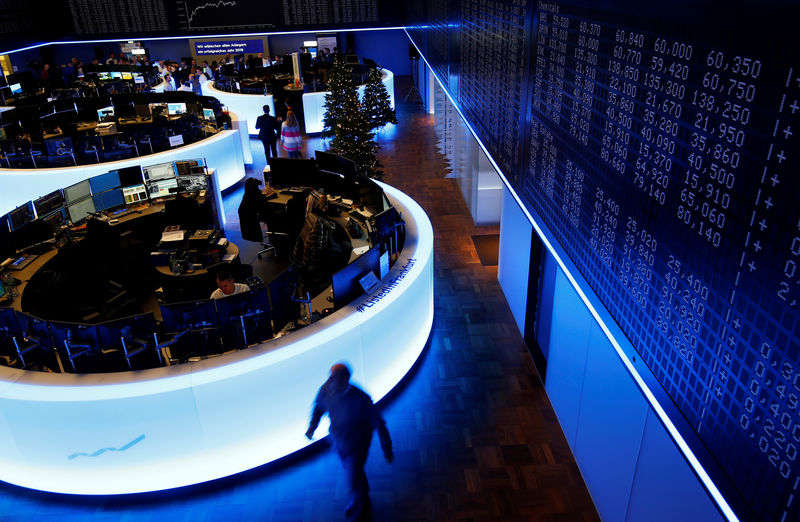
European equities were mostly subdued, with the Stoxx 600 up 0.1% as investors weighed the potential expiration of the U.S.-Iran ceasefire and mixed signals on renewed peace talks. Oil prices dipped but remain above pre-war levels, while ASML rose more than 1% on AI optimism and Amazon's planned up to $25 billion investment in Anthropic. Apple’s Frankfurt-listed shares were slightly lower after Tim Cook was named to step down as CEO, with John Ternus set to succeed him on September 1.
The equity tape is signaling a bifurcation: the market is rewarding scarce, high-leverage AI infrastructure names while treating governance transitions at mature mega-caps as a modest de-rating event rather than a thesis break. That makes sense because the marginal capital right now is chasing capacity constraints in the AI supply chain, not consumer hardware narratives; any pullback in AAPL is more about a lower “certainty premium” than an earnings reset. The more important second-order effect is that AI capex remains concentrated among a handful of hyperscalers, which supports equipment vendors with bottlenecks and pricing power while leaving broader software names more vulnerable if the spending cycle proves narrower than expected.
ASML’s move is not just a sympathy bid; it reflects the market’s willingness to pay up for the few picks-and-shovels names that can monetize AI even if end-demand wobbles. The upside is that supply-chain leverage can compound quickly when leading-edge spending accelerates, but the risk is that this becomes a crowded “quality scarcity” trade where any export-control headline, semiconductor capex digestion, or China-related demand disappointment can trigger abrupt multiple compression over the next 1-3 months. The better lens is relative performance versus other semiconductor capital equipment names and memory exposure, where earnings revisions may be stronger but balance-sheet quality is lower.
The geopolitics/energy setup is still a vol-of-vol problem more than a clean directional oil thesis: the market is pricing a lower probability of immediate supply disruption, but not enough to remove tail risk. That favors options or relative-value structures over outright commodity longs because the next headline can gap crude either way within days, while broader inflation expectations and rate sensitivity remain asymmetric over weeks. In Europe, the biggest underappreciated loser is not just energy-intensive industry; it is any company with pass-through lag and weak pricing power, which could see margins squeezed if crude rebounds before contract resets.
The consumer/retail and Pepsi-linked move is a reminder that distribution partnerships can matter more than product demand in the short run. Breaking a regional bottling or distribution relationship can impair shelf presence and local execution faster than it hits reported revenue, making this a potentially multi-quarter earnings compression story rather than a one-off event. More broadly, any restructuring announcement in consumer staples should be read as a signal that managements are trying to unlock hidden asset value in a slower-growth environment, which can create short-term upside but often raises execution risk for 6-12 months.
AI-powered research, real-time alerts, and portfolio analytics for institutional investors.
Request TrialOverall Sentiment
neutral
Sentiment Score
-0.05
Ticker Sentiment
