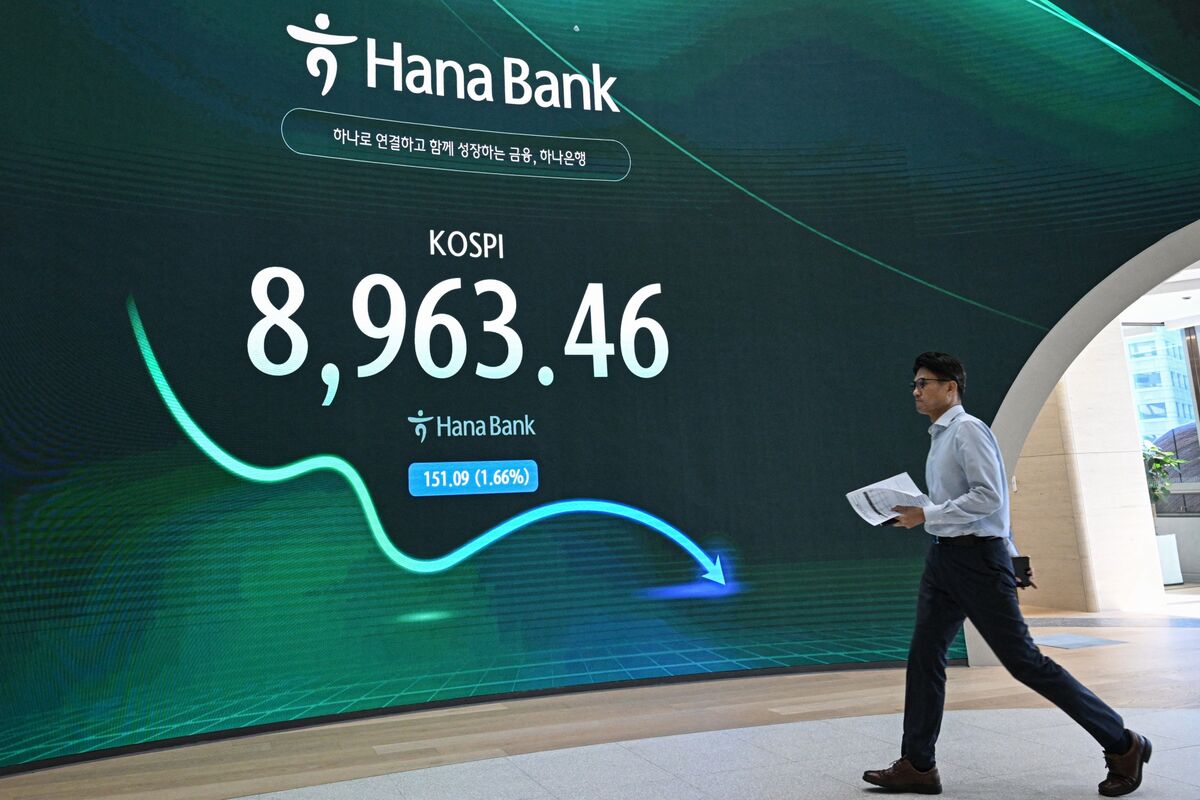
South Korea’s Kospi has closed up or down at least 5% on 20 occasions this year, including a 10% plunge on Tuesday, highlighting an unusually volatile market environment. The move is being compared with the 2021 meme-stock frenzy as retail participation drives sharper intra-day swings, despite support from strong chipmaker earnings. The article signals elevated risk appetite and instability rather than a clear fundamental deterioration.
The key takeaway is not “Korea is becoming a meme market,” but that dealer balance sheets are likely becoming the marginal source of instability. When retail dominates intraday order flow, volatility feeds on itself through tighter intraday risk limits, wider spreads, and more aggressive hedging by local market makers; that creates an increasingly reflexive tape where a benign headline can still produce outsized moves. The second-order effect is that liquidity disappears exactly when it is most needed, so realized volatility can stay elevated even if fundamental earnings remain intact.
That matters for global vol as a cross-asset signal. A market with strong cyclical semiconductor exposure but unstable positioning becomes a poor place to run leveraged long beta, because forced de-grossing can spill into ADRs, sector ETFs, and option-implied vol surfaces. In practice, the risk is less about a fundamental collapse in Korean earnings and more about a repeated funding/liquidity event over the next several weeks if local retail participation stays hot and systematic players keep selling into the swings.
The contrarian view is that this may be a tradable volatility regime rather than a directional equity bear market. If the underlying earnings backdrop remains firm, repeated drawdowns should attract dip-buying from domestic institutions and global allocators looking for chip exposure at lower effective multiples. The consensus may be overestimating the likelihood of a sustained crash and underestimating how much of the move is simply path-dependent leverage unwinding; once the intraday amplitude compresses, a sharp vol crush could be the better expression than outright shorts.
For now, the cleanest expression is to own volatility, not delta. A market that has already produced multiple 5%+ daily swings this year is telling you that short-dated options are underpricing gap risk until the next forced unwind. The trade setup is asymmetric because the catalyst window is short: any further retail blowoff, index rebalance, or macro shock can reprice vol in days, while the normalization path likely takes months.
AI-powered research, real-time alerts, and portfolio analytics for institutional investors.
Request DemoOverall Sentiment
mildly negative
Sentiment Score
-0.15
Ticker Sentiment
