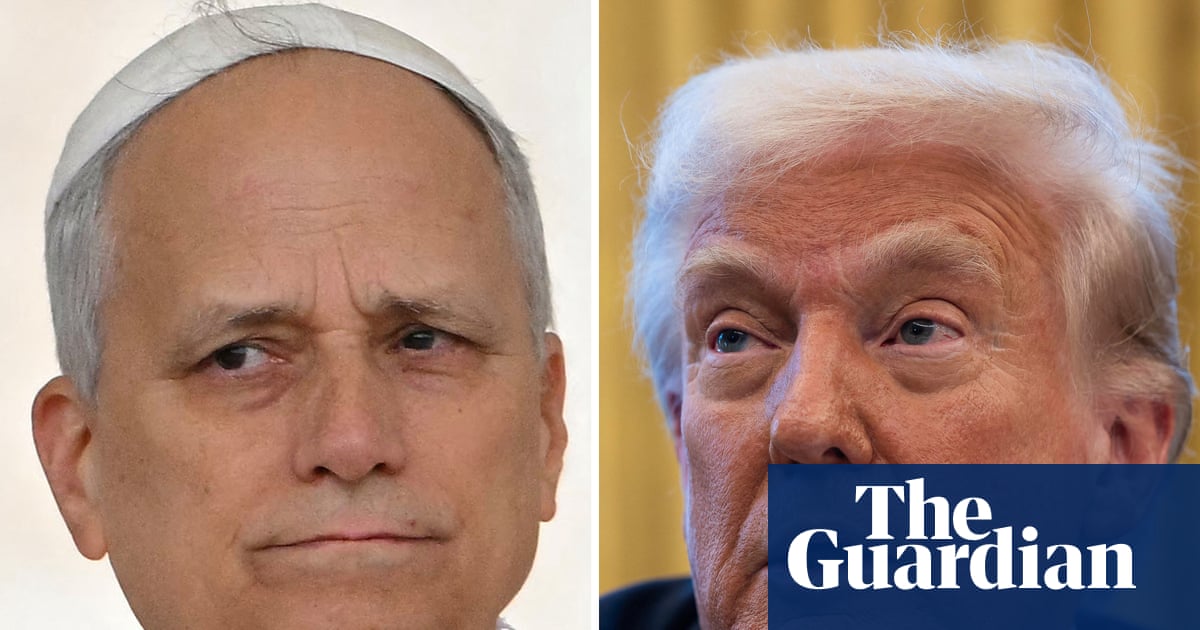
The article centers on Pope Leo XIV's condemnation of the US bombing campaign in Iran and President Trump's escalating criticism, including threats against Iran and an AI-generated image of himself as Christ. The main economic relevance is indirect, reflecting heightened geopolitical and political risk rather than a direct market-moving policy shift. It also highlights softening support for Trump among some Catholic voters, but the piece is primarily about faith, politics, and public sentiment.
The marketable signal here is not theology; it is the widening gap between Trump’s core coalition and the coalition margin that actually decides swing elections. When cultural respect norms are violated this explicitly, the incremental damage is less about hardcore supporters leaving and more about soft Catholic suburban voters rationalizing a shift to “issue over personality,” which is how defections start before showing up in polls. That creates a slow-burn headwind for Trump-aligned policy trade assumptions, especially where his base is strongest but persuasion is weakest: exurban Atlanta, Philadelphia collar counties, and Rust Belt Catholic belts.
The second-order effect is on informational throughput: AI-generated provocation is becoming a cheap, repeatable attention weapon, but each use also raises the penalty for sloppy authenticity. If voters begin treating synthetic content as moral transgression rather than just noise, campaigns and media distributors face higher moderation, verification, and legal-review costs over the next 6-18 months. That favors platforms and publishers with trust architecture, while pure engagement-maximizers risk higher churn from brand-sensitive advertisers even if the immediate audience spike remains intact.
On geopolitics, the pope’s anti-war stance is not market-moving by itself, but it can amplify the political cost of escalation if the Iran situation worsens. The key tail risk is a feedback loop where religious condemnation hardens domestic opposition to military action, constraining White House optionality and increasing the probability of policy whiplash after any further threat cycle. In that scenario, defense names tied to prolonged escalation may underperform while oil retains a bid from risk premia rather than fundamentals; the more interesting trade is volatility, not direction.
The contrarian read is that the apparent Catholic backlash may be overstated in the near term because many voters are still sorting identity from policy outcomes. But the erosion is likely asymmetric: once moral credibility is damaged, it is harder to reverse than a single policy disagreement. That makes this a polling-tail risk story over weeks to months, not a hard catalyst tomorrow morning.
AI-powered research, real-time alerts, and portfolio analytics for institutional investors.
Request DemoOverall Sentiment
neutral
Sentiment Score
-0.05
