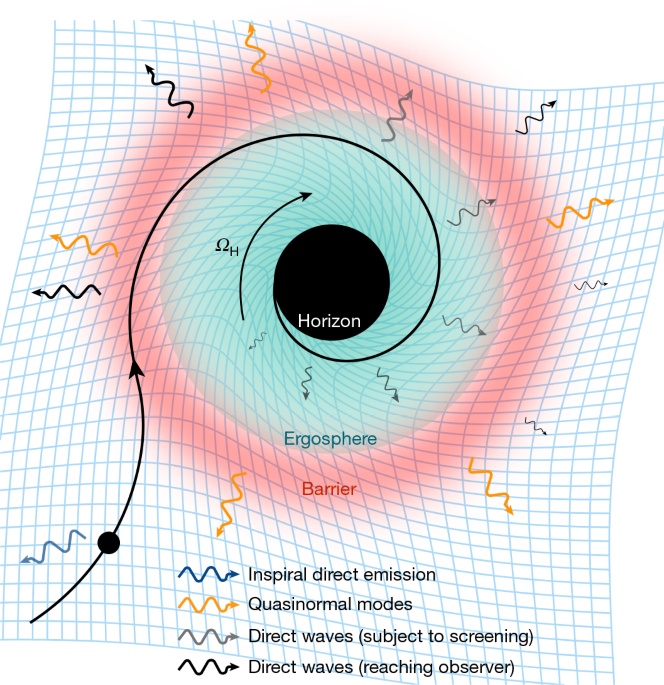
Nature reports observational evidence of a post-merger black-hole “direct wave” in GW250114, with a 90% credible matched-filter SNR of 15.8 in Hanford and 17.1 in Livingston. The measured signal properties are said to match Kerr black-hole predictions, providing a new observational channel to probe frame dragging and near-horizon physics. This is a scientific breakthrough, but it has limited direct market relevance.
This is not an investable event in the direct sense, but it is a strong catalyst for the gravitational-wave industrial stack. The near-term beneficiaries are the enabling layer: precision instrumentation, cryogenics, vacuum systems, photonics, FPGA/data-acquisition vendors, and the cloud/HPC providers that monetize increasingly data-heavy inference workflows. The second-order read is that each step toward waveform decomposition makes the ecosystem less “one-off science” and more recurring software + compute spend, which is exactly the kind of conversion path that can eventually pull academic demand into commercial procurement cycles.
The bigger market implication is for platform winners in adjacent deep-tech portfolios: companies selling ultrastable lasers, low-noise sensors, RF/microwave components, and high-throughput scientific compute should see this as an incremental validation of capex intensity, not a one-time headline. If this line of research continues, detector upgrades and data-analysis tooling become a multiyear budget cycle rather than a discretionary grant cycle, supporting order visibility for specialized suppliers. The risk is that scientific proofs-of-concept often overstate addressable spend; monetization can stall if the field standardizes around a narrow set of open-source methods.
The contrarian point is that the signal’s significance may be underappreciated for software than for hardware: the defensible edge will likely sit in filtering, model selection, calibration, and inference pipelines, not in the detectors themselves. That creates a niche but real opportunity for vendors of simulation software, scientific ML, and high-end workflow orchestration. Near term, the trade is on “picks and shovels,” not the headline science names, because the science narrative is positive but the cash-flow translation will be slow and uneven.
AI-powered research, real-time alerts, and portfolio analytics for institutional investors.
Request DemoOverall Sentiment
mildly positive
Sentiment Score
0.20
