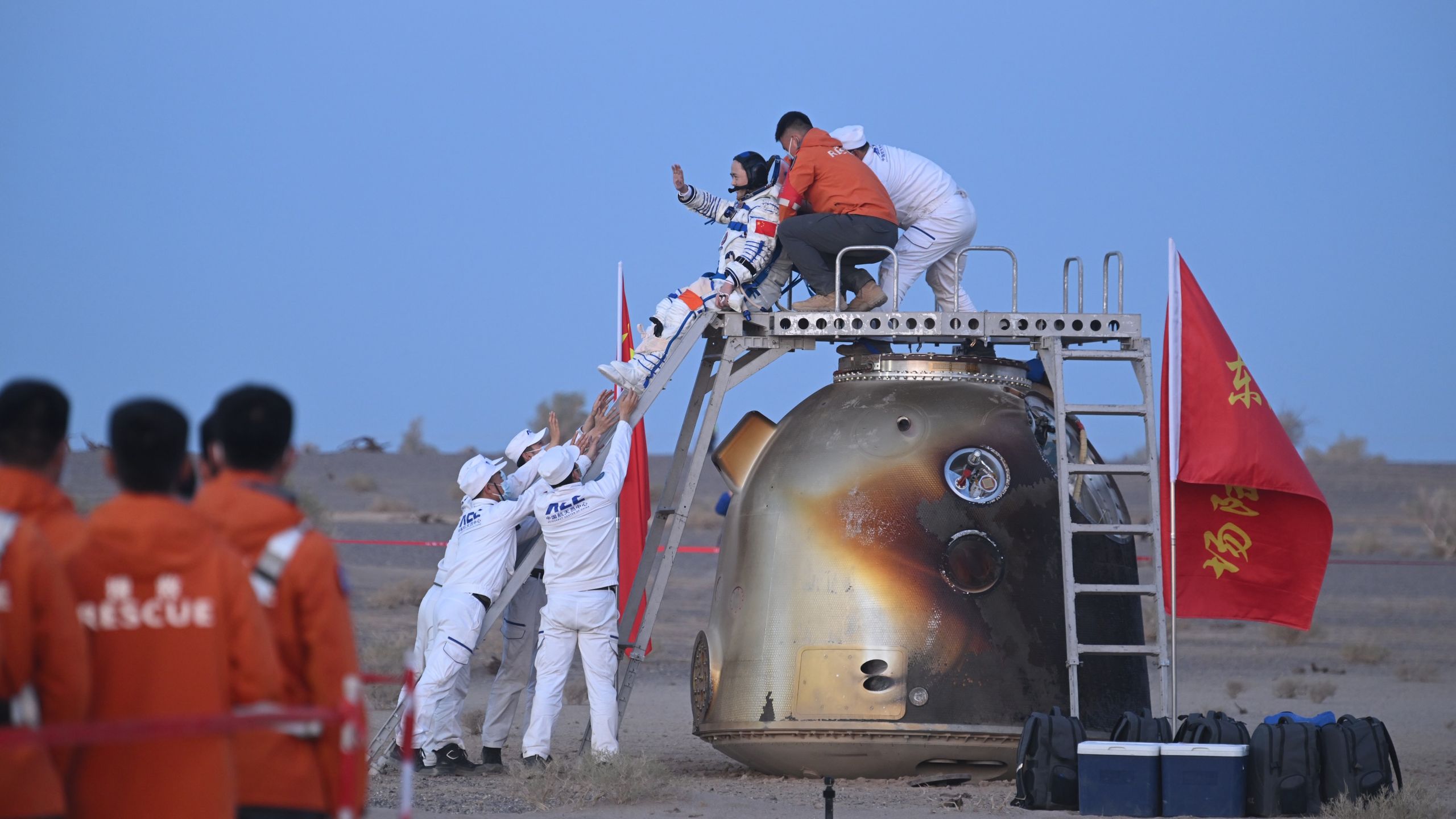
China's Shenzhou 21 astronauts returned safely after 210 days in space, a record for a Chinese crewed mission, and landed at the Dongfeng site on May 29. The mission was notable for an orbital debris-related capsule crack that forced a vehicle swap and an uncrewed launch of Shenzhou 22, but all astronauts and spacecraft involved ultimately returned safely. The article is primarily a factual update on China's human spaceflight program with limited direct market impact.
The marketable takeaway is not the mission itself; it is the signal that China is treating orbital debris resilience as an operational priority, not a hypothetical. That shifts the marginal spend from prestige-led exploration into a more durable procurement cycle around crewed-capsule hardening, debris detection, autonomous rescue capability, and launch redundancy. In practice, that is bullish for domestic Chinese aerospace suppliers and systems integrators with exposure to guidance, avionics, radiation-hardened components, and ground-support infrastructure, even if the near-term reaction stays muted because these budgets are largely state-directed and not yet fully transparent.
The second-order effect is competitive: once a crewed program is forced to create and maintain a backup vehicle pipeline, it increases cadence, inventory, and testing costs while simultaneously lowering tolerance for single-point failures. That tends to favor firms and ecosystems that can sell redundancy, not just lift capacity. It also raises the strategic value of launch services and range infrastructure in Asia, because a “ready spare spacecraft” doctrine implies more frequent pad slots, more spares in production, and more demand for mission assurance software and tracking services over the next 12-24 months.
The contrarian read is that this is mildly bullish for the broader space-industrial complex but not a clean catalyst for the obvious U.S. names; public-market investors may overestimate the near-term revenue impact and underestimate the procurement lag. The better trade is to look for beneficiaries with direct exposure to sovereign space spending, satellite situational awareness, and aerospace test equipment rather than pure exploration stories. Tail risk is an escalation in debris incidents, which would accelerate procurement and could pull forward demand by quarters; the reverse is a quiet period that keeps this as a headline without budget follow-through.
AI-powered research, real-time alerts, and portfolio analytics for institutional investors.
Request DemoOverall Sentiment
neutral
Sentiment Score
0.05
