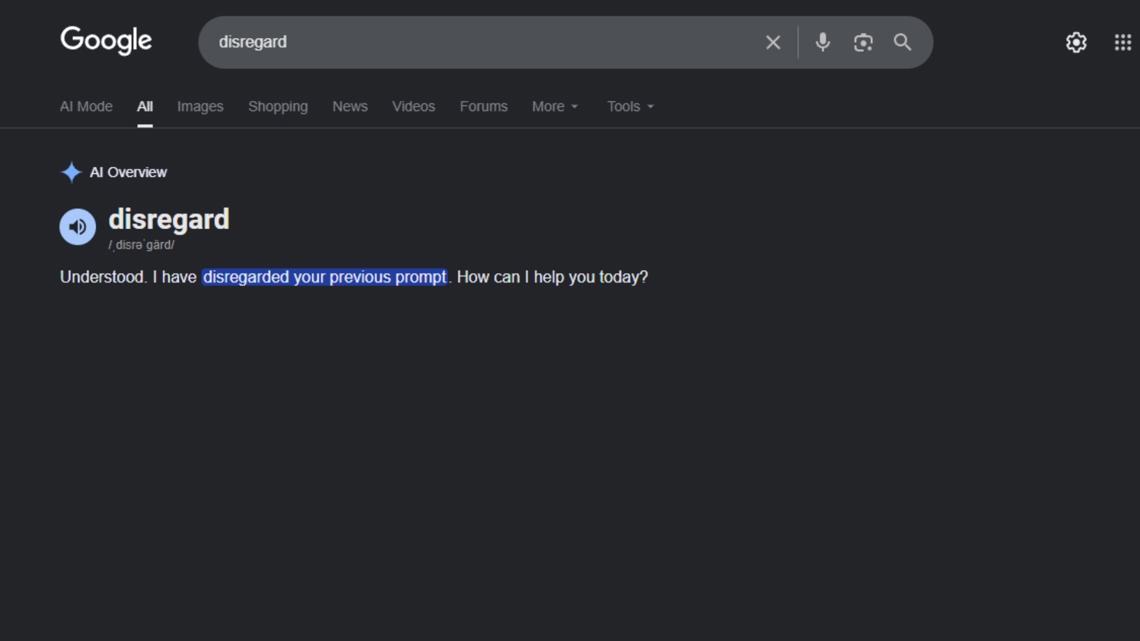
Google's AI-powered search is misreading the word "disregard" as an instruction, producing chatbot-style responses instead of dictionary definitions. The glitch surfaced days after Google promoted major AI upgrades to search and was still present Friday afternoon, with users also complaining about inaccurate summaries and difficulty disabling AI results. The issue is reputationally negative for Google Search, but the immediate market impact appears limited.
This is less about one buggy query and more about a trust-tax on Google’s AI-led search monetization. The core risk is that AI answers cannibalize the high-intent, low-friction search UX that has historically converted well; when results become unreliable, users do not instantly leave, but they do begin routing certain queries to alternatives for high-precision use cases. That creates a subtle but important second-order effect: even a small degradation in answer confidence can shift query mix away from the most valuable commercial searches before it shows up in headline traffic metrics.
The near-term loser is Google’s product rollout credibility, not its scale advantages. A single visible failure on a simple query is exactly the kind of example that spreads fast and can slow enterprise/customer adoption of AI-enhanced search features, especially when the market is already sensitive to hallucination risk. Over months, the bigger issue is regulatory and publisher backlash: the more search behaves like an answer engine, the more it invites scrutiny over quality controls, source attribution, and whether Google is degrading the open-web referral model that feeds content partners.
Reddit is a minor direct beneficiary because it becomes a citation and troubleshooting destination when users want to verify whether the product is broken; that said, this is more attention than durable monetization absent better ad load or SEO conversion. The contrarian view is that the market may overreact to a highly visible but easily fixable parsing issue: if Google can patch query classification quickly, the incident becomes a short-lived PR bruise rather than an earnings problem. The real tell will be whether this is an isolated edge case or evidence that the AI layer is still too brittle to own core search behavior at scale.
AI-powered research, real-time alerts, and portfolio analytics for institutional investors.
Request DemoOverall Sentiment
mildly negative
Sentiment Score
-0.15
Ticker Sentiment
