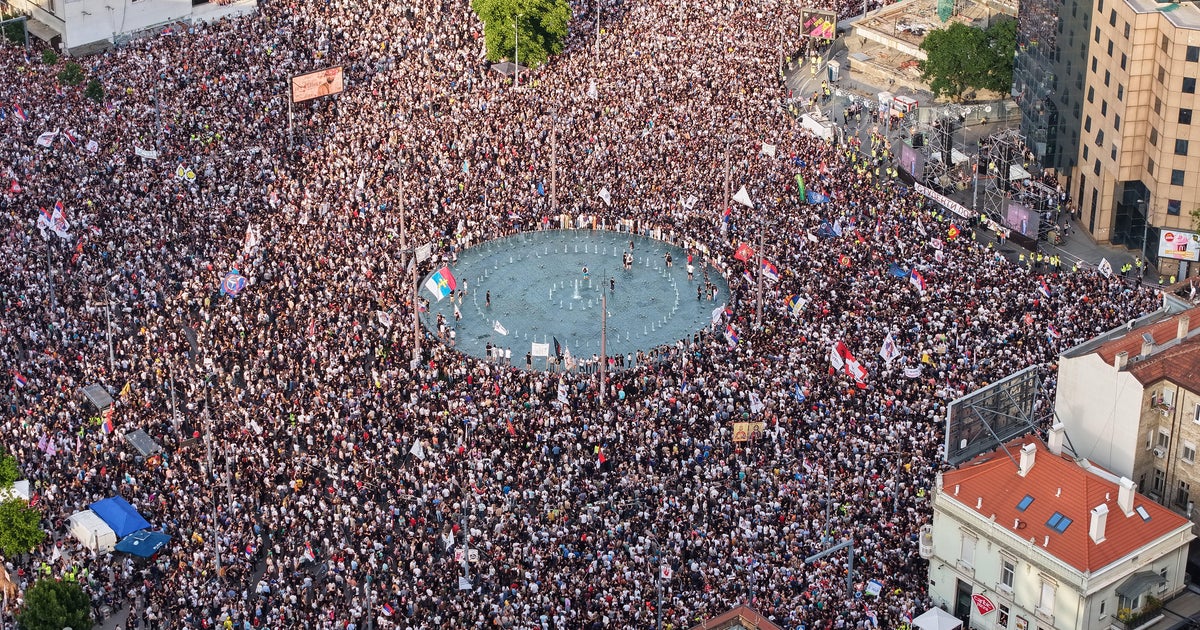
Thousands of anti-government protesters clashed with riot police in Belgrade after a massive rally, with police using pepper spray as demonstrators threw flares, rocks and bottles. The unrest underscores continued political instability in Serbia, where student-led protests are demanding early parliamentary elections, rule of law, and accountability over a 2024 train station tragedy that killed 16 people. The article is politically significant but likely limited in direct market impact unless unrest escalates further.
This is less a one-day street event than a regime-risk escalation for a small, externally financed EM with weak institutional trust. The key second-order effect is not immediate policy change but decision paralysis: when a government has to dedicate more security resources to domestic control, investor-facing reforms slow, procurement decisions get delayed, and local currency assets tend to gap on any sign of coercion or capital flight. The market is likely underpricing how quickly political stress can transmit into funding costs because Serbia sits in the awkward middle ground of being EU-adjacent but not fully insulated by EU institutional backstops.
The near-term winning trade is in the relative, not absolute, expression. Domestic banks, builders, and infrastructure-linked names are the most exposed if protests morph into a broader legitimacy crisis, because they are the first lever for credit tightening, permit delays, and public-capex reprioritization. By contrast, exporters with hard-currency revenues and little policy dependence should be more resilient if the dinar comes under pressure; the second-order beneficiary is the external balance, as political uncertainty usually compresses imports before it hurts exports.
Catalyst path matters: over days, the market can shrug this off unless police violence triggers a larger student coalition or labor participation. Over months, the real risk is an early-election framework that becomes a referendum on governance rather than on any single issue; that tends to widen sovereign spreads and delay FDI, especially in infrastructure and energy-transition projects. The contrarian read is that the protest energy may be durable but not yet coordinated enough to force a clean transition, so the base case is more volatility than regime change — which argues for tactical hedges rather than outright bearish country bets.
AI-powered research, real-time alerts, and portfolio analytics for institutional investors.
Request DemoOverall Sentiment
moderately negative
Sentiment Score
-0.35
