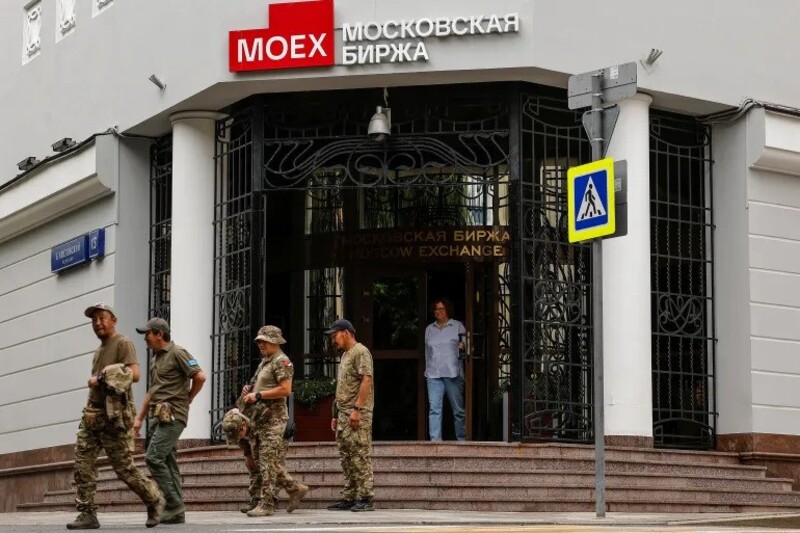
The article is mostly a market wrap: the MOEX Russia Index was unchanged, with gainers led by PhosAgro (+0.70%), Magnit (+0.54%), and Moskovskaya Birzha (+0.41%), while LUKOIL fell 4.94%, Rosneft dropped 1.24%, and TATNEFT declined 0.80%. Commodity moves were mixed, with gold up 0.32% to $4,661.40/oz, crude oil down 2.98% to $101.94/bbl, and Brent down 5.12% to $108.17/bbl. FX was stable, with USD/RUB unchanged at 74.95 and EUR/RUB down 0.09% to 87.85.
The most important signal here is not the quarterly profit print; it is the scale of optionality created by the cash balance. When a mega-cap allocator is sitting on a near-record liquidity buffer while public markets are bifurcating, it effectively becomes a barometer for risk appetite: if this capital is not being deployed aggressively, the message to cyclicals and levered balance sheets is that capital remains expensive and M&A/repurchases will stay selective. That tends to support high-quality balance-sheet leaders and compress valuation dispersion rather than trigger a broad market melt-up.
The commodity tape is more interesting than the equity move. A sharp drawdown in crude alongside firm gold implies a regime where growth fears are overtaking inflation fears, but not enough to force a full risk-off break in FX or vol. That mix is usually hostile to upstream energy equities in the very near term because investors first de-rate EBITDA expectations before adjusting service costs, and the second-order impact is negative for oilfield services and high-beta EM resource producers. The most exposed names are those with the highest operating leverage to spot oil and the least hedging discipline; the best relative shelter is downstream/refining, integrateds with strong balance sheets, and producers with low sustaining capex.
The FX stability is a warning that this may be a positioning flush rather than a macro trend change. If USD/RUB stays anchored while Brent weakens, local equity pressure can persist through lower energy receipts and weaker fiscal optics even without immediate currency stress. Over the next 2-6 weeks, watch for whether energy weakness propagates into broader EM commodity baskets; over 3-6 months, the key reversal catalyst would be either a geopolitical supply shock or evidence that global demand is not rolling over as quickly as the price action suggests.
AI-powered research, real-time alerts, and portfolio analytics for institutional investors.
Request DemoOverall Sentiment
neutral
Sentiment Score
-0.05
