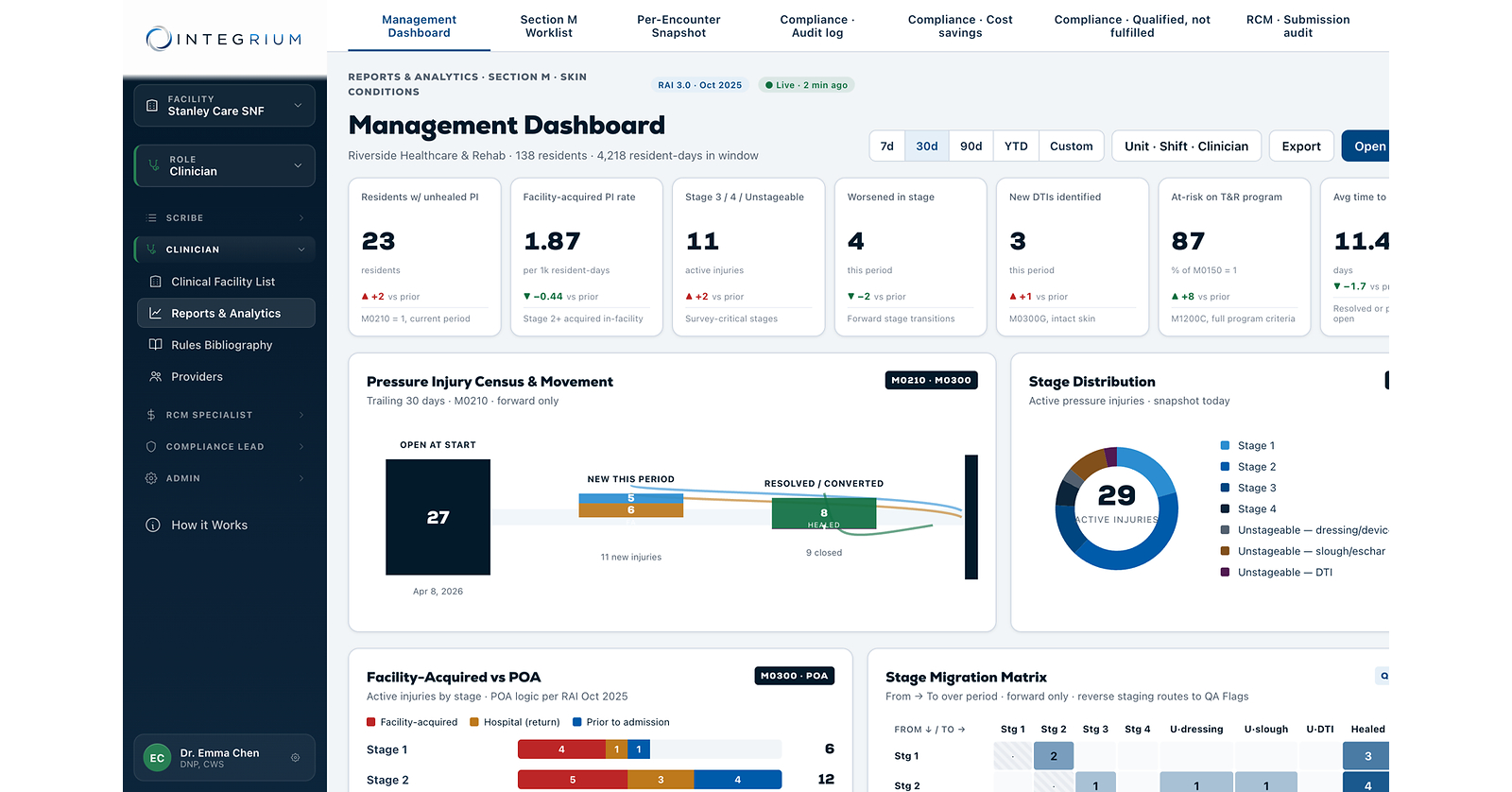
Integrium CORE launched as a FHIR-native, compliance-first EHR aimed at making post-acute wound care documentation “audit-ready.” The platform auto-checks encounters against NCCI edits and LCD documentation rules, applies PDPM/RAI requirements and the 2026 skin-substitute rules, and generates a complete audit trail for billing decisions (rule ID, match result, decision). It also ships with connected modules including structured wound documentation, a 3D body map, point-of-care wound tracking, and a facility-connected view for long-term care operators.
This is less a product launch than a monetization claim on documentation risk. The economic value is in reducing denial leakage and audit remediation, so the first beneficiaries are wound-care operators and post-acute facilities that already have enough volume to care about a 1-3% swing in net reimbursement or staff time per encounter. If the workflow is genuinely deterministic, it can compress the addressable market for outsourced coding and add-on compliance tools, but only after buyers prove the switch does not increase implementation friction.
Competitive impact is most acute in niche post-acute software, not broad hospital EHR. The likely losers are legacy workflow vendors and billing-service overlays that sell manual compliance labor; the second-order effect is that competition shifts from feature breadth to measurable claim yield and audit defensibility. That favors vendors with tight integrations and strong rule maintenance, while making generic AI-assisted documentation tools look fragile if they cannot show reproducible outcomes.
The main risk is that this is still a promise until there are signed deployments, ONC progress, and hard metrics on denied-claim reduction. Near term, there is probably no listed-equity trade; over 1-3 months, watch for customer references and any CMS/payer commentary that validates the pain point. Over 6-18 months, if adoption broadens, the structural winner is the customer base via lower leakage, while the vendor moat depends on whether its compliance engine remains ahead of rule changes rather than just sounding better in a press release. The contrarian view is that the market may be overpricing "compliance-first" as a moat: once ROI is proven, incumbents can bolt on similar rule engines, and switching costs may matter more than product elegance.
AI-powered research, real-time alerts, and portfolio analytics for institutional investors.
Request TrialOverall Sentiment
mildly positive
Sentiment Score
0.25
