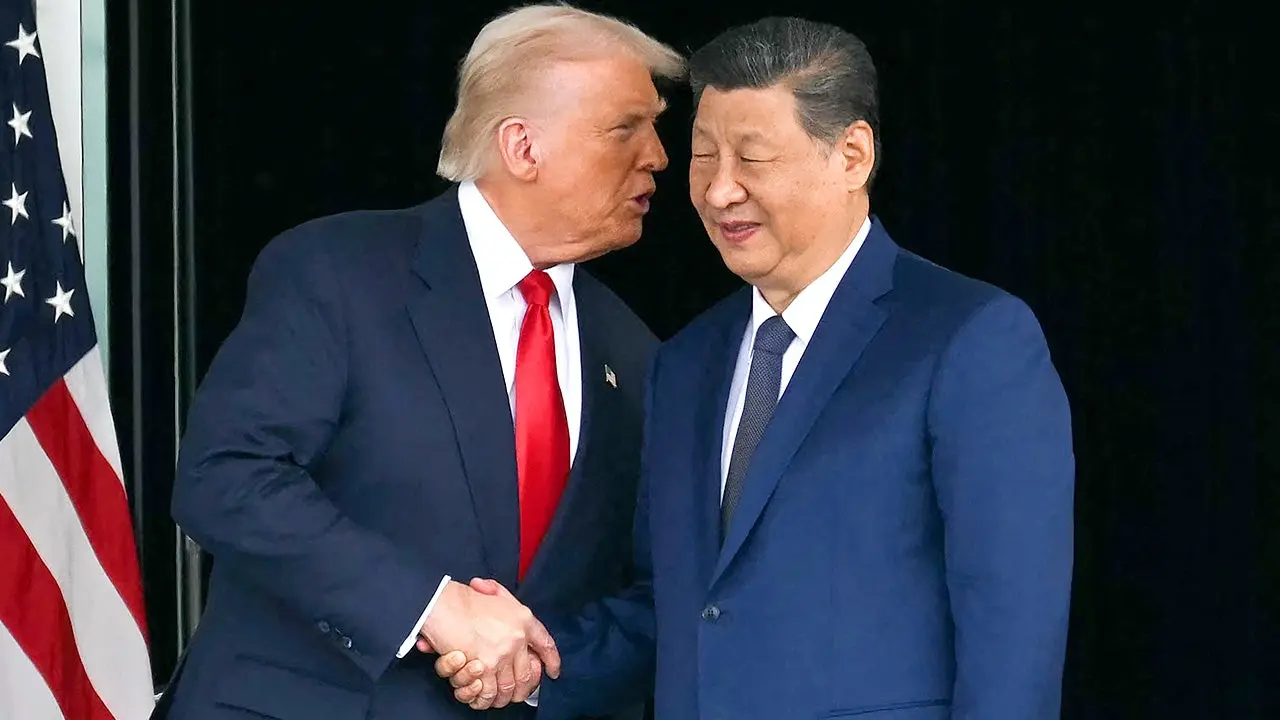
Trump arrived in Beijing for high-stakes talks with Xi Jinping centered on Taiwan, trade, U.S.-China strategic rivalry, and China’s support for Russia and Iran. The visit also puts export controls and AI at the forefront, with Nvidia CEO Jensen Huang among the executives traveling with Trump as Washington seeks wider access for U.S. firms in China. The summit carries broad market relevance given potential implications for trade policy, supply chains, energy flows, and geopolitical risk.
This is less a binary “deal/no deal” event than a cross-asset volatility catalyst concentrated in three channels: export controls, China market access, and energy/shipping risk. The most immediate market reaction should be in the semis complex, where Beijing has incentive to promise incremental access while Washington has limited willingness to relax controls; that asymmetry tends to produce headline-positive but economically modest outcomes. In other words, any near-term relief rally in AI hardware is more likely to fade unless there is explicit guidance on licensing, packaging, or end-use enforcement.
The more interesting second-order effect is competitive reallocation inside U.S. tech and industrials. If China offers selective openings, capital will likely flow first to companies with already-established distribution and service footprints, not to the highest-growth names with the most restrictions. That favors diversified multinational platforms over pure-play China exposure, while the presence of major U.S. executives makes it harder for the administration to walk away from a “deliverable” that can be framed as commercial progress.
On the downside, the Iran/energy backdrop keeps the probability of a negative surprise elevated over the next few days. If the summit produces no credible de-escalation language on sanctions enforcement or shipping security, oil could reprice higher on risk premium even without a supply shock, which would pressure global cyclicals and raise the odds that Beijing leans harder into stockpiling and supply-chain de-risking. Taiwan remains the tail risk with the largest convexity: even a brief rhetorical escalation would overwhelm trade optimism and force a fast unwind in China-sensitive U.S. equities.
Consensus looks too focused on whether this is “good” or “bad” for markets, when the actual edge is dispersion. The likely outcome is a narrow set of winners from selective access and a broader set of losers from continued strategic friction, especially where valuations already assume smooth China re-acceleration. That makes this a better event for relative-value expression than outright beta.
AI-powered research, real-time alerts, and portfolio analytics for institutional investors.
Request DemoOverall Sentiment
neutral
Sentiment Score
-0.05
Ticker Sentiment
