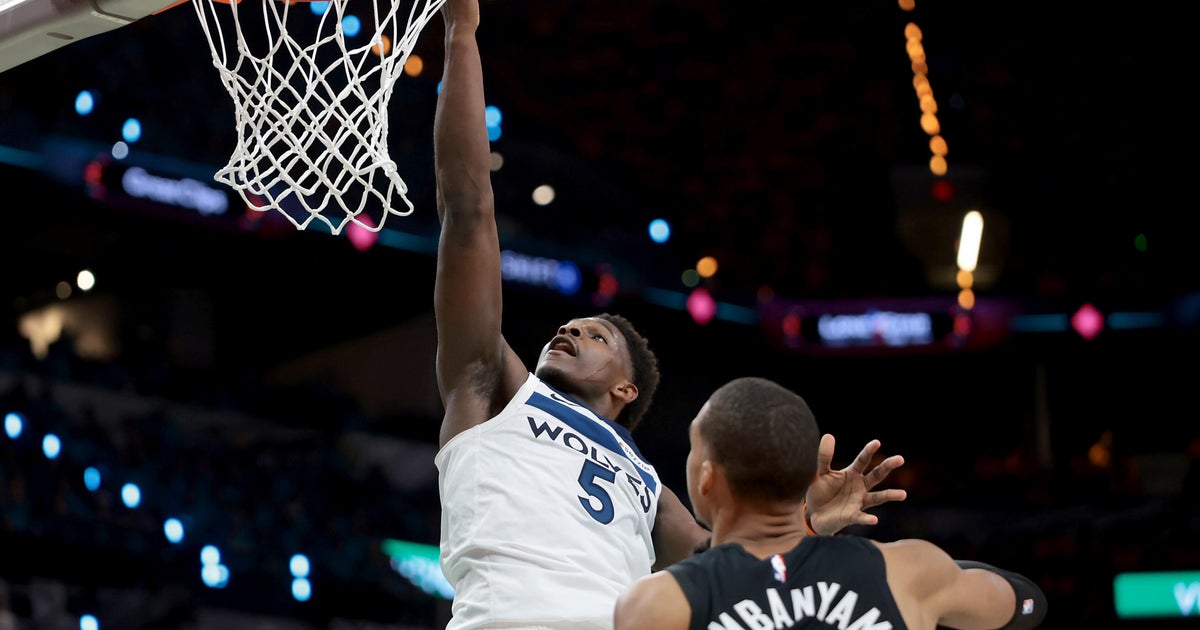
Anthony Edwards returned 10 days after hyperextending his left knee and scored 18 points, including 11 in the fourth quarter, to lead Minnesota to a 104-102 win in Game 1 of the Western Conference semifinals. He played 25 minutes off the bench after being expected to miss the first two games, while Victor Wembanyama recorded 11 points, 15 rebounds and an NBA postseason-record 12 blocked shots. The article is largely sports performance news with limited direct market impact.
This is less a one-game basketball story than a signal that the market’s default injury-risk discount is often too blunt for high-usage stars with elite recovery infrastructure. When a primary creator returns ahead of schedule and still looks playable in leverage minutes, the real edge shifts to lineup continuity: the team with the healthier on-ball engine can force rotations, improve half-court shot quality, and compress underdog variance immediately. That matters most in series where the opponent’s defensive identity is built around physicality and rim protection, because one healthy initiator can neutralize multiple layers of scheme rather than just add points.
The second-order effect is on opponent asset prices: teams that rely on a singular rim anchor or matchup-specific defensive edge tend to be more fragile when their game plan is forced into late-game scoring trades. A high-block, low-scoring center can dominate possession value over a game, but if the matchup star can still create efficient shots in the final six minutes, the defensive surplus gets partially monetized away. In practical terms, this kind of return tends to widen the gap between what the market thinks is a "safe" home opener edge and what the series actually prices once the favorite’s best player proves available.
From a risk perspective, the key horizon is the next 48-72 hours: if the minutes restriction is lifted too fast, the probability of re-aggravation rises meaningfully, especially on deceleration and contact plays. Over a multi-game series, the more relevant catalyst is not the box score but whether the player can sustain fourth-quarter creation without a usage cliff; if not, the team’s offensive rating can fall sharply in Game 3-4 when fatigue compounds. The contrarian point is that the real underreaction may be on the health signal itself: if this staff can accelerate return timelines safely, the team’s title probability deserves a higher floor than a simplistic injury model would imply.
AI-powered research, real-time alerts, and portfolio analytics for institutional investors.
Request DemoOverall Sentiment
mildly positive
Sentiment Score
0.20
