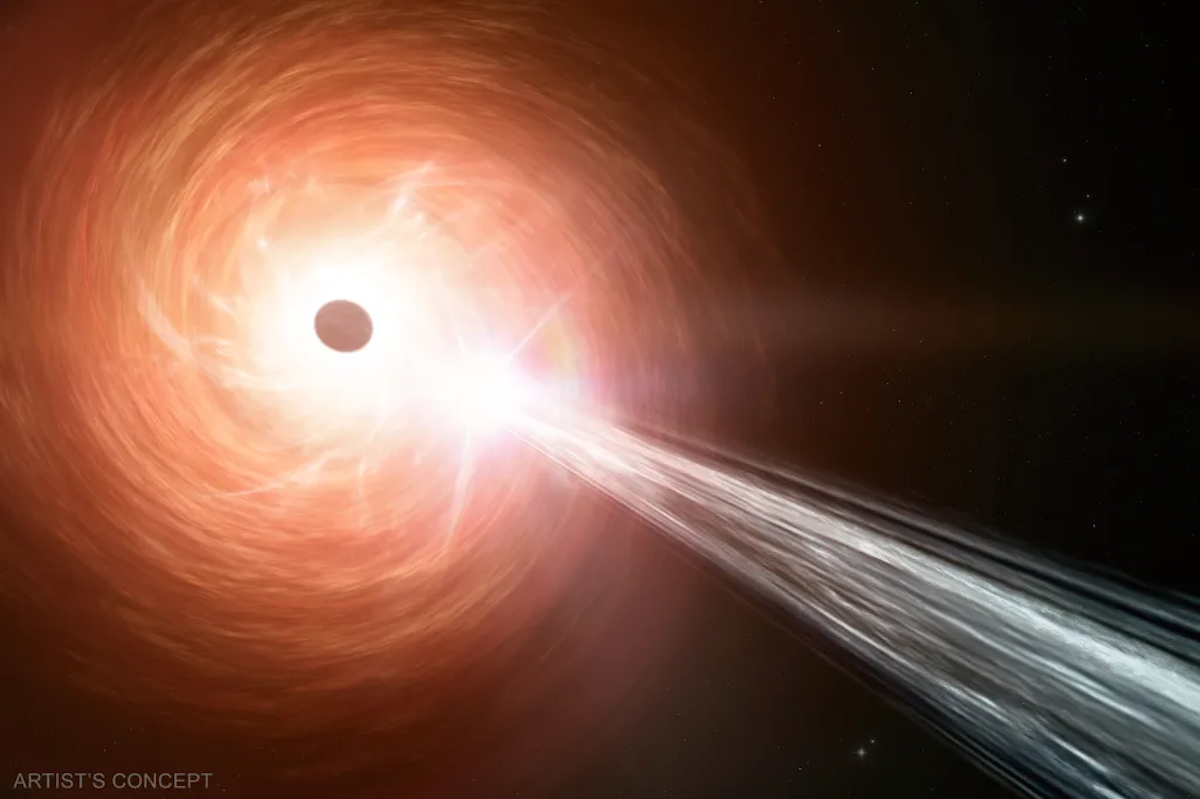
XRISM data on NGC 4151 show a roughly 10,000-second, or just under 3-hour, delay between black hole X-ray flares and the onset of ultra-fast outflows. The study provides the first direct timing link for magnetocentrifugal wind launching and introduces 'cindicity,' a new metric that estimates the probability of active galaxy-quenching winds from X-ray brightness and spectral hardness. The work is scientifically significant for galaxy-formation models, but it is unlikely to have an immediate market impact.
This is not just an astrophysics headline; it is a tooling upgrade for the entire AGN quenching thesis. The second-order implication is that feedback is moving from a population-level modeling assumption to a source-level, timestamped observable, which should compress uncertainty around how much of galaxy evolution is actually driven by accretion-state changes versus stochastic gas supply. That matters because the market analog here is instrument-enabled differentiation: when measurement precision jumps, the leaders are not the object being studied but the platforms, workflows, and data pipelines that can convert scarce high-resolution observations into scalable diagnostics.
The near-term winner set is concentrated in mission-adjacent hardware, cryogenics, detector calibration, and downstream data-analysis software. XRISM-like capabilities create a flywheel: better spectral resolution increases the value of follow-on campaigns, which raises utilization for observatories and boosts grant flow into universities and subcontractors that can operationalize time-domain X-ray monitoring. The loser, if any, is the “broad-brush” simulation framework: models that rely on tunable feedback efficiencies without an event-time anchor are now more exposed to falsification, so the overhang is on generic modeling vendors and legacy methods rather than any single public equity.
The key risk is over-extrapolation from one bright, nearby, unusually tractable galaxy to the broader AGN population. The useful horizon is months to years, not days: if cindicity generalizes, expect a wave of confirmatory studies and a sharp increase in target selection efficiency; if it does not, this remains a compelling case study but not a universal diagnostic. The consensus may be underestimating how quickly a single robust timing metric can turn into a selection engine for observing time, meaning the real economic value is in observational triage, not the astrophysical result itself.
AI-powered research, real-time alerts, and portfolio analytics for institutional investors.
Request DemoOverall Sentiment
mildly positive
Sentiment Score
0.20
