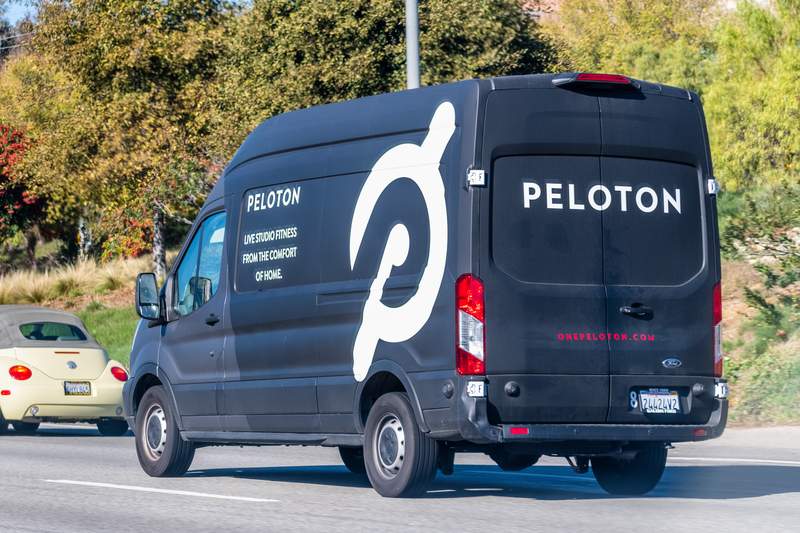
Telsey reiterated a Market Perform rating and $6 price target on Peloton, implying modest upside from the current $5.45 share price based on a 1.25x EV/sales multiple applied to FY2026 sales of $2.42 billion. The firm sees improving financial footing, supported by $173.2 million in trailing EBITDA, ~52% gross margin, and plans to buy back $200 million of 0% convertible debt, but still sees no clear near-term inflection in hardware sales or member growth. Near-term attention is on May 7 earnings, while the Spotify partnership and lower 25% fitness-equipment tariff are incremental positives.
PTON is in a classic “quality without growth” setup: the balance sheet repair and margin stabilization reduce bankruptcy risk, but the equity still needs either a hardware reacceleration or an unexpected monetization vector to justify meaningfully higher multiples. The near-term upside is less about core bikes/treads and more about whether distribution partnerships can create lower-CAC user acquisition at scale; if Spotify meaningfully broadens the top of funnel, it could compress the company’s payback period on marketing and re-rate subscription durability.
The key second-order effect is competitive: a fitness platform embedded inside a broader media subscription is more defensible than a standalone app, which pressures smaller connected-fitness and boutique platforms that rely on direct consumer intent. If Peloton’s content starts functioning as a low-friction funnel into its ecosystem, the margin structure could improve without requiring a large unit-sales inflection, but that requires evidence of conversion rather than just awareness.
The market is likely underpricing the financing optionality: reducing expensive debt/refi risk in 2026 can improve equity value even if top-line growth remains flat, because every 100 bps lower interest expense matters at this scale. The bear case is that the demand mix shift away from cardio is structural, not cyclical, which would make hardware the wrong lever and leave the stock range-bound until management proves a new category can offset mature-bike saturation. With earnings imminent, the catalyst window is days, but the real test is the next 2-3 quarters of subscriber adds and attach rates from new channels.
Contrarian view: the consensus is focused on whether Peloton can grow again, but the more important question may be whether it can sustain high free cash flow while shrinking refinancing risk. If so, this can work as a de-leveraging story with modest multiple expansion rather than a full turnaround, which is enough for a 15-25% move but not necessarily for the triple-digit upside implied by the most bullish calls.
AI-powered research, real-time alerts, and portfolio analytics for institutional investors.
Request DemoOverall Sentiment
neutral
Sentiment Score
0.15
Ticker Sentiment
