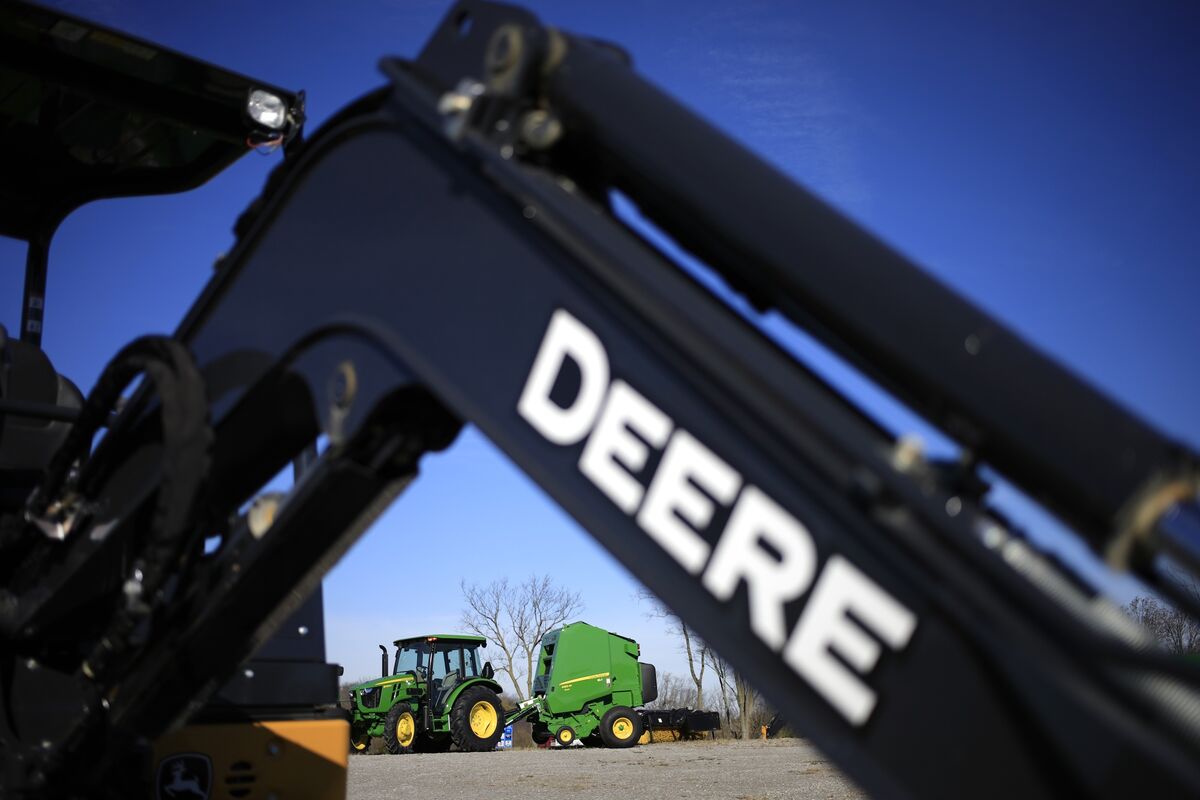
Deere reiterated full-year net income guidance of $4.5 billion to $5 billion, unchanged from February and roughly in line with the $4.79 billion Bloomberg estimate. Gains in construction and forestry are offsetting a still-weak agricultural market, leaving the outlook broadly steady rather than improving materially. The update is modestly supportive but unlikely to drive a large broader-market reaction.
The key takeaway is not the headline guidance itself, but the mix shift beneath it: construction/forestry is acting as a demand ballast while ag remains the drag. That creates a more durable earnings profile than a pure cyclical inflection, because non-ag end markets tend to be less rate-sensitive than row-crop economics and can sustain backlog longer if public infrastructure and housing maintenance stay firm. The market is likely underestimating how much this can compress downside volatility in near-term margins even if farm sentiment stays weak for another 2-3 quarters.
The second-order effect is competitive. A stable guide from the category leader raises the bar for smaller ag-equipment peers with more concentrated farm exposure and less service mix; they are more vulnerable to inventory correction and dealer destocking if producers keep deferring capex. Suppliers into engines, hydraulics, and precision components may see a bifurcated order book: better pull-through from construction machines, weaker from tractors/combines. That mix should favor companies with higher aftermarket/service penetration and exposure to North American construction over those reliant on replacement ag cycles.
From a risk standpoint, the real catalyst is not the next quarter but the next planting/harvest decision set: if commodity prices and farm incomes fail to recover into the next cycle, the ag slump can extend into fiscal 2026, capping multiple expansion. Conversely, any sharp move lower in rates or a rebound in crop prices would quickly leverage operating profit because dealer inventories are already the swing factor. The consensus may be too anchored to agriculture weakness and underappreciating that construction can keep the earnings floor elevated even without a broad macro re-acceleration.
AI-powered research, real-time alerts, and portfolio analytics for institutional investors.
Request DemoOverall Sentiment
neutral
Sentiment Score
0.05
