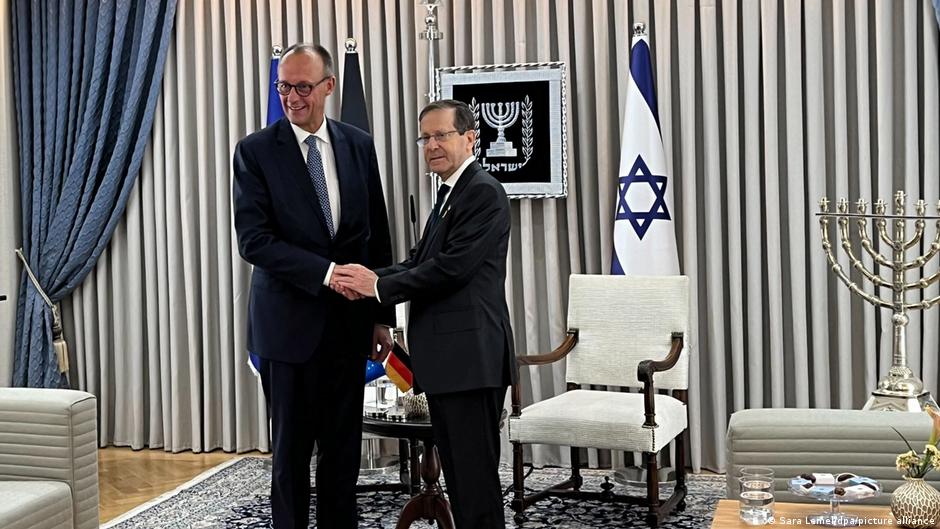
German Chancellor Friedrich Merz made his first official visit to Jordan and Israel, reaffirming Germany’s commitment to Israel while acknowledging recent dilemmas over a now-lifted partial halt on weapons deliveries. Merz met King Abdullah II and Israeli President Isaac Herzog, endorsed a two-state solution, urged increased humanitarian aid to Gaza and discussed regional security including the Israeli Arrow 3 missile-defence link to Germany; he is scheduled to meet Prime Minister Benjamin Netanyahu and visit Yad Vashem and families of hostages. The trip aims to stabilize bilateral ties after tensions over Israel’s Gaza offensive and signal continued German engagement in diplomatic and security arrangements in the region.
Market structure: Stabilization of German-Israeli ties and the lifted partial arms halt is a net positive for defense primes that supply air/missile-defense and electronics — expect incremental demand for Rheinmetall (RHM.DE), Hensoldt (HAG.DE) and Israeli contractors such as Elbit (ESLT) as procurement risk falls. Export insurers and credit agencies (Euler Hermes/Allianz P&C exposure) also gain from resumed shipments; civilian sectors tied to reconstruction or Gaza aid see ambiguous near-term flows. FX/ rates: reduced political tail-risk should mildly tighten safe-haven flows vs. EUR and compress Bund-Treasury basis by a few bps if markets price lower geopolitical premia.
Risk assessment: Tail risks include rapid escalation in the Israel-Gaza theater driving oil +$10/bbl spikes and a sovereign/emerging-market risk-off; probability low but impact high for commodities and global rates. Immediate (days) market moves likely muted; short-term (weeks–months) hinge on procurement announcements and EU export-policy harmonization; long-term (6–24 months) depends on Bundestag budget increases and concrete Israel-Germany industrial partnerships. Hidden dependency: any material order flow requires parliamentary export approvals and co-financing — announcements without approval will be quickly discounted.
Trade implications: Direct plays — small, tactical allocations to defense names and ETFs: overweight RHM.DE and HAG.DE, and ESLT for Israeli exposure; use 6–12 month call spreads (25% OTM) to limit capital and capture rerating on confirmed contracts. Pair trade — long aerospace & defense ETF (ITA) vs short airline ETF (JETS) to express security-driven capex vs travel cyclical risk. Entry timing: initiate pilot positions now (1–3% portfolio per name), scale to target after a procurement announcement or Bundestag vote within 2–12 weeks; take profits at +25–40%, stop-loss -12%.
AI-powered research, real-time alerts, and portfolio analytics for institutional investors.
Request DemoOverall Sentiment
neutral
Sentiment Score
0.00
Contrarian angles: Consensus understates the role of German export-credit and indemnity flows — if Bundesrepublik offers ECA-backed financing for Israeli systems, valuations for mid-cap suppliers could re-rate 20–50% within 12 months. Risk is underappreciated that EU strategic-autonomy moves could favor EU suppliers over Israeli vendors, so prefer EU-listed primes (HAG.DE, RHM.DE) over ESLT if political fragmentation increases. Watch for short-term overreaction if diplomacy falters; avoid levering into headlines.
