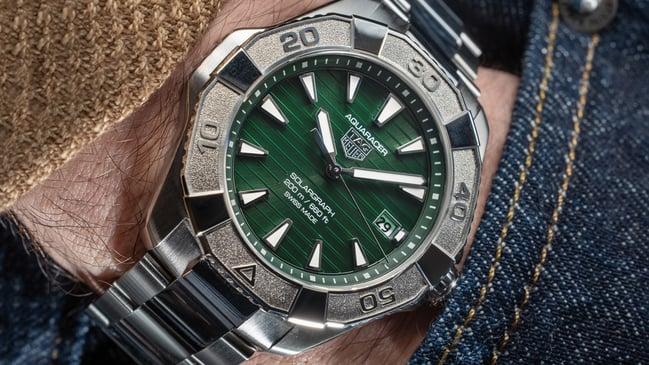
TAG Heuer unveiled updated Aquaracer Solargraph models with new sculpted bezels, a revised case shape, a quick-change bracelet system on 40mm models, and a new 28mm size. The 40mm Aquaracer Pro 200 Solargraph uses Caliber TH50-00, offers 200m water resistance, and is priced from $3,100 to $3,850, while the 28mm Pro 100 Solargraph uses Caliber TH51-00, offers 100m water resistance, and is priced from $3,050 to $3,350. The article is primarily a product-refresh piece with limited immediate market impact.
This is less about a single watch SKU and more about TAG Heuer defending the mid-luxury “entry aspiration” lane with a product architecture that narrows the gap between fashion-cycle refreshes and genuine industrial design upgrades. The sculpted bezel, more symmetrical case geometry, and quick-change bracelet system all increase perceived value without materially changing unit economics, which is exactly the kind of margin-positive product theater that can support full-price sell-through in a soft discretionary backdrop. The key second-order effect is competitive: it forces peers in the $3k-$4k range to spend more on case finishing and modularity just to avoid looking dated, pressuring gross margins across the category.
The 28mm launch matters because it widens the addressable shopper set rather than merely remixing existing demand. That tends to help brands with strong retail distribution and hurts smaller independents that rely on one-size-fits-all hero models; the broader assortment can also lift attachment rates in boutiques because the smaller size often functions as an incremental gift/occasion purchase. The solar-quartz platform is strategically important too: it lowers maintenance friction versus mechanical alternatives, which can improve conversion among first-time luxury buyers who are price-sensitive on ownership cost but status-sensitive on brand.
The contrarian risk is that these are incremental improvements, not a true step-change, so demand elasticity may be weaker than launch-day enthusiasm suggests. If consumer spending softens over the next 1-2 quarters, watch for discounting at authorized dealers and slower replenishment at the lower end of the price band first; that would indicate the “upgrade” thesis is being used to mask inventory clearance. Another overlooked risk is that rapid feature parity across the industry makes quick-release bracelets and sculpted bezels table stakes within 12-18 months, compressing differentiation faster than management teams can monetize it.
AI-powered research, real-time alerts, and portfolio analytics for institutional investors.
Request DemoOverall Sentiment
mildly positive
Sentiment Score
0.20
