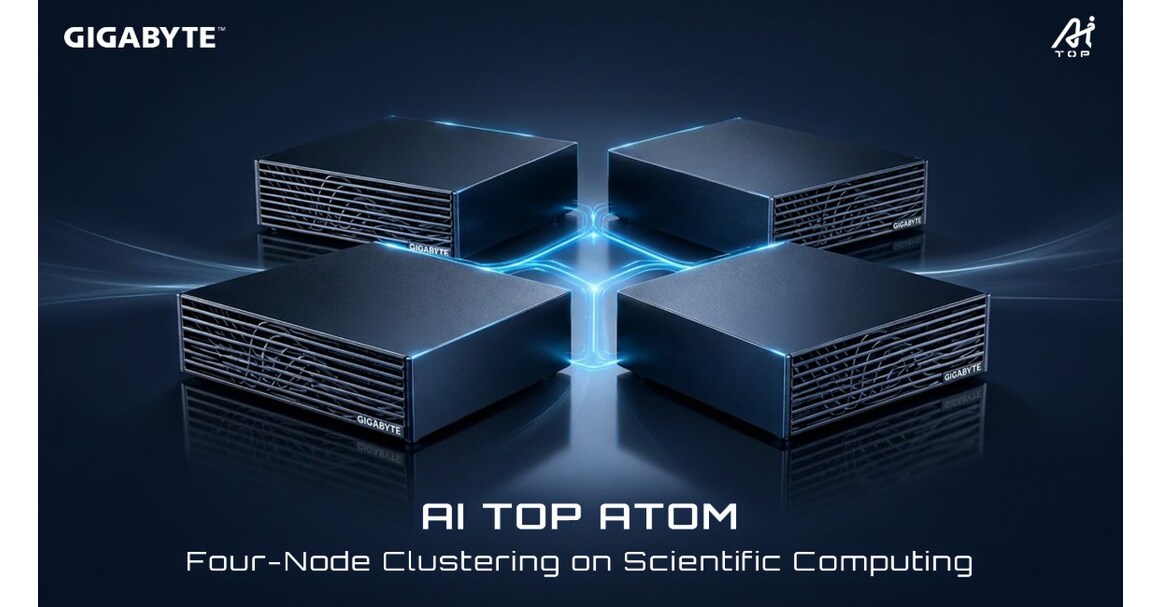
GIGABYTE présente son cluster AI TOP ATOM à quatre nœuds pour le calcul scientifique local, avec 1 PFLOPS de puissance IA FP4 et 128 Go de mémoire unifiée par nœud. Les nœuds sont interconnectés via un switch 200 GbE compatible RoCE, permettant à des charges mémoire-intensives d’aller au-delà des limites d’un système autonome, avec des simulations étendues de ~10M d’atomes à plus de 30M d’atomes. En partenariat avec NVIDIA, le démonstrateur combine NemoClaw et des modèles open source (Nemotron-3-Nano-30B-NVFP4) et GROMACS pour des cas d’usage de simulation de matériaux TIM pour l’encapsulation avancée des semi-conducteurs.
The incremental signal for NVDA is not the demo itself but the continued broadening of AI demand from training into memory-heavy scientific workflows that favor high-end accelerators, interconnect, and software lock-in. If this category becomes real budget line-item spend, it supports a longer runway for enterprise/server GPU attach rates and makes the mix less dependent on hyperscaler capex cycles. That said, the likely revenue contribution near term is still immaterial versus NVDA’s overall scale; this is more about validating the TAM expansion narrative than changing next-quarter numbers.
The second-order winner is the NVIDIA ecosystem around networking and cluster integration, while commodity OEM assemblers are likely to capture the least economic value because the system is modular and increasingly standardized. If local/sovereign AI gains traction, it can create a small but persistent shift away from centralized cloud inference toward on-prem deployments, which may modestly pressure cloud utilization at the margin over 6-18 months. The main structural read-through is that data-sovereignty requirements can become a gating factor for enterprise AI adoption, which is supportive for on-prem GPU servers even if it slows hyperscaler concentration.
The contrarian view is that the market may be over-reading a showcase into a demand inflection. These pilots often validate a technical roadmap long before they create meaningful unit volume, and the economic winner is often the software/platform owner rather than the box seller. The thesis would be falsified if enterprise AI server bookings fail to accelerate over the next 1-2 quarters, or if NVDA’s data center backlog / networking attach does not show any benefit from on-prem cluster adoption.
AI-powered research, real-time alerts, and portfolio analytics for institutional investors.
Request DemoOverall Sentiment
mildly positive
Sentiment Score
0.15
Ticker Sentiment
