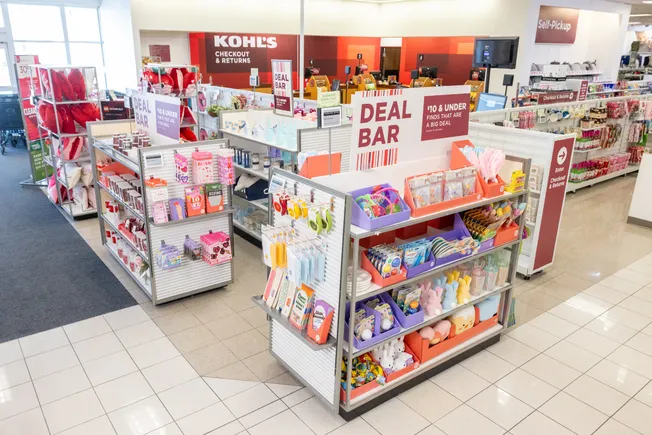
Kohl’s Q4 net sales fell nearly 4% y/y to $5.0B with comps down nearly 3%, while Q4 net income rose ~160% to $125M and gross margin expanded 25bps to 33.1%. For the full year, net sales declined 4% to $14.8B, comps -3.1%, gross margin +34bps to 37.5% and net income +150% to $272M; 2025 cash flow was about $1.0B after ~$400M capex. Management issued cautious 2025 guidance of net sales and comps down as much as 2% or flat and plans merchandising, pricing and marketing changes rather than major store closures. Analysts remain skeptical that current initiatives are sufficient to restore sales momentum, making 2026 a pivotal year for stabilization.
Kohl’s current program — SKU rationalization, sharper private-label focus and “value” assortments — should materially improve inventory turns and reduce promotional leakage if executed cleanly. A disciplined cut in SKUs can free up ~2-4% of working-capital tied to slow movers and improve gross margin mix by 100–200bps over 12–24 months, but only if the vendor base accepts tighter purchase windows and allocations.
The strategic externality here is share capture by stronger omnichannel and off-price players: Target and TJX can monetize Kohl’s missteps without incremental investment, because they already own superior digital traffic funnels and faster replenishment cycles; this will compress Kohl’s top-line elasticity and raise customer acquisition costs. Conversely, vendors will preferentially allocate hot-sell items to partners with higher sell-through, creating a feedback loop that accelerates Kohl’s assortment weakness unless merchandising execution materially tightens.
Near-term catalysts to watch are cohort-level comp trends, inventory/sales velocity, promotional depth (implicit markdown cadence) and vendor terms; absent sequential improvement across these four metrics, price-led traffic initiatives will only buy time. Tail risks include an adverse macro shock that forces aggressive clearance activity (eroding margins) or a breakdown in vendor relationships that limits newness — both would push a multi-quarter recovery into a multi-year one.
AI-powered research, real-time alerts, and portfolio analytics for institutional investors.
Overall Sentiment
mildly negative
Sentiment Score
-0.18
Ticker Sentiment
