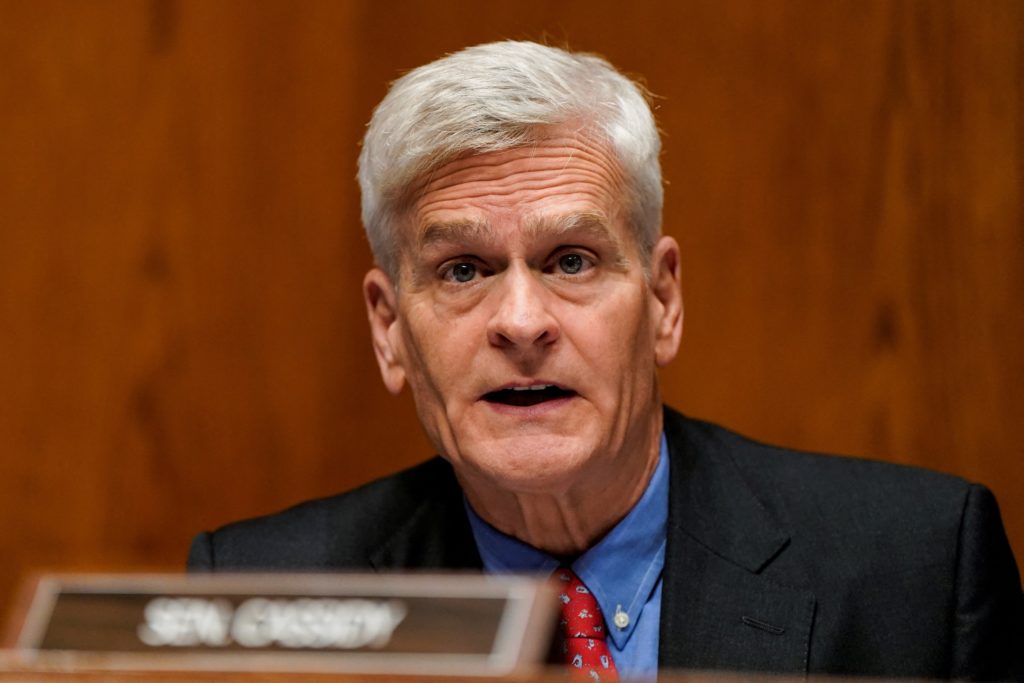
U.S. Sen. Bill Cassidy is facing a Trump-backed Republican primary challenge in Louisiana, with Trump endorsing Rep. Julia Letlow and attacking Cassidy as "a disloyal disaster." Cassidy is spending heavily, roughly $9.6 million on ads through May 16 versus Letlow's $3.9 million, but the race is expected to hinge more on Trump loyalty and turnout confusion than policy. The article also highlights Cassidy's clashes with Robert F. Kennedy Jr. over vaccine policy and the state's delayed House primaries after redistricting changes.
This is less about one Louisiana seat and more about whether Trump can still impose discipline on Republican incumbents through endorsement alone. The market-like read is that the primary is being treated as a referendum on loyalty, which raises the expected payoff to visible alignment with Trump and compresses the value of institutional seniority. That dynamic is already spilling into policy risk: senators in health-adjacent roles will be more reluctant to oppose executive-branch nominees or vaccine-related cuts if they think a primary challenge can be weaponized.
The second-order effect is governance degradation rather than an immediate legislative shift. If incumbents conclude that procedural expertise and cross-pressured policy positions are liabilities, Senate committees become more partisan and less capable of moderating Health/FTC/FDA nominations, increasing volatility around biotech, vaccine manufacturers, and managed-care regulatory outcomes over the next 6-18 months. The confusion around ballot administration adds a turnout asymmetry: lower-information Republicans are more likely to defer to Trump cues, while institutional conservatives who value independence may be undercounted if participation is suppressed.
The contrarian angle is that the anti-incumbent swing may be overread as a clean Trump victory. A three-way race with a runoff means the first-round result can exaggerate Trump’s strength if the anti-Cassidy vote fragments, but that same fragmentation can also rescue Cassidy if he survives into June and consolidates non-Trump Republicans. If he hangs on, the signal to the market is not “Trump always wins,” but rather that expensive, well-funded incumbents with local infrastructure can still withstand a loyalty test, which would reduce the expected probability of future successful primary purges.
AI-powered research, real-time alerts, and portfolio analytics for institutional investors.
Request DemoOverall Sentiment
neutral
Sentiment Score
-0.05
