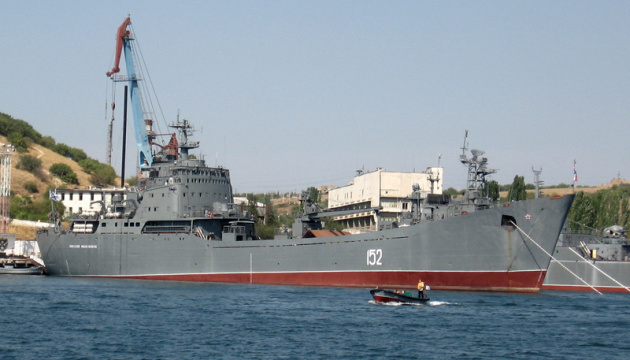
Ukraine's Security Service said drone strikes hit three Russian naval vessels, a MiG-31 aircraft, and air defense facilities in occupied Crimea, including the Sevastopol base and Belbek airfield. The reported damage includes the Yamal and Filchenkov landing ships, the Ivan Khurs reconnaissance ship, and radar/intelligence assets. The incident underscores continued escalation in the Black Sea theater and raises risk for regional military and energy-related assets.
This is less about the immediate platforms hit and more about the continued degradation of Russia’s denial-and-control architecture in the Black Sea theater. The second-order effect is a higher probability of intermittent but persistent disruption to sortie generation, ISR coverage, and naval logistics, which forces Russia to either disperse assets further from the peninsula or accept lower operational tempo. That tends to widen the gap between headline strike damage and the longer-lived operational impairment, which is what markets usually underprice in geopolitically sensitive names.
The market implication is a mild-to-moderate risk-off impulse for assets exposed to Black Sea shipping, regional logistics, and European energy/transit security, but the bigger effect is on the option value of escalation. Each incremental strike raises the tail risk of asymmetric Russian retaliation against Ukrainian infrastructure and potentially NATO-adjacent logistics nodes, which can keep risk premia elevated for weeks even if spot headlines fade. The relevant horizon is days for tactical volatility, but months for any sustained re-rating of defense, cyber, and alternative logistics beneficiaries.
Consensus may over-focus on kinetic damage and underweight the depletion of scarce air-defense and sensor assets, which are far harder to replace than drones. If that trend continues, Russia’s ability to defend rear-area infrastructure weakens nonlinearly, making follow-on strikes cheaper and more effective; that is the key compounding risk. The contrarian risk is that success here encourages Russia to shift to broader retaliation elsewhere, which could temporarily dampen the relative outperformance of Europe-exposed cyclicals and increase dispersion within defense equities rather than lift the whole complex uniformly.
AI-powered research, real-time alerts, and portfolio analytics for institutional investors.
Request DemoOverall Sentiment
strongly negative
Sentiment Score
-0.70
