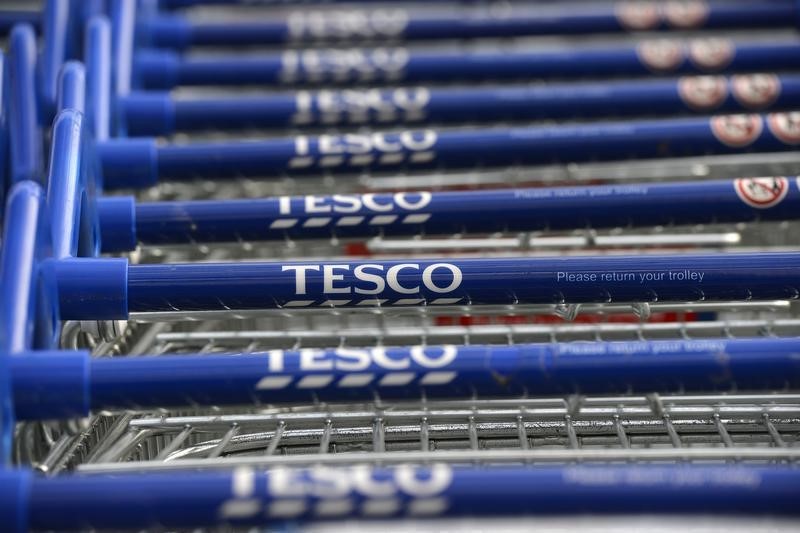
Tesco raised its 2026/27 adjusted operating profit outlook to £3.0bn-£3.3bn, above the prior analyst consensus of about £3.23bn, while also targeting £500m of additional cost savings. For 2025/26, revenue rose 4.3% on a constant-currency basis to £66.6bn, adjusted EPS reached 29.0p, and like-for-like sales increased 3.5%. The upgrade reflects uncertainty from the Middle East conflict, but the article frames the underlying trading update as modestly better than expected.
The market is treating the Middle East truce as a clean disinflationary impulse, but the more important second-order effect is a shift in household budget stress from fuel to food. A defensive grocer with pricing power and scale tends to absorb that mix better than discretionary retail, so TSCO’s ability to reaffirm/raise through an uncertainty shock is a signal that value-seeking, basket-management behavior is still intact. The wider margin of safety here is not demand growth; it is mix resilience and procurement leverage while smaller competitors face less room to absorb cost volatility.
The key wrinkle is that this kind of guidance revision can become self-defeating if investors extrapolate it too far. If the conflict de-escalates quickly, the “uncertainty premium” embedded in food-at-home demand may fade, and some of the recent defensiveness rotates back out of staples into cyclicals over the next 1-3 months. Conversely, if energy or shipping costs re-accelerate, the benefit to grocery traffic could be offset by margin pressure from imports, labor, and logistics, so the trade is less about headline geopolitics and more about the durability of UK real-income pressure into the next results cycle.
Consensus is probably underestimating how much of Tesco’s outperformance comes from operating discipline rather than top-line strength. The cost-savings target matters because it gives management a buffer to protect price investment without sacrificing cash generation, which should lower downside in a weaker macro tape. The overdone part is the assumption that “better than expected guidance” automatically means multiple expansion; for a mature food retailer, sustained rerating usually requires evidence that cash conversion and market-share gains persist for several quarters, not one reassuring print.
AI-powered research, real-time alerts, and portfolio analytics for institutional investors.
Request DemoOverall Sentiment
mildly positive
Sentiment Score
0.25
Ticker Sentiment
