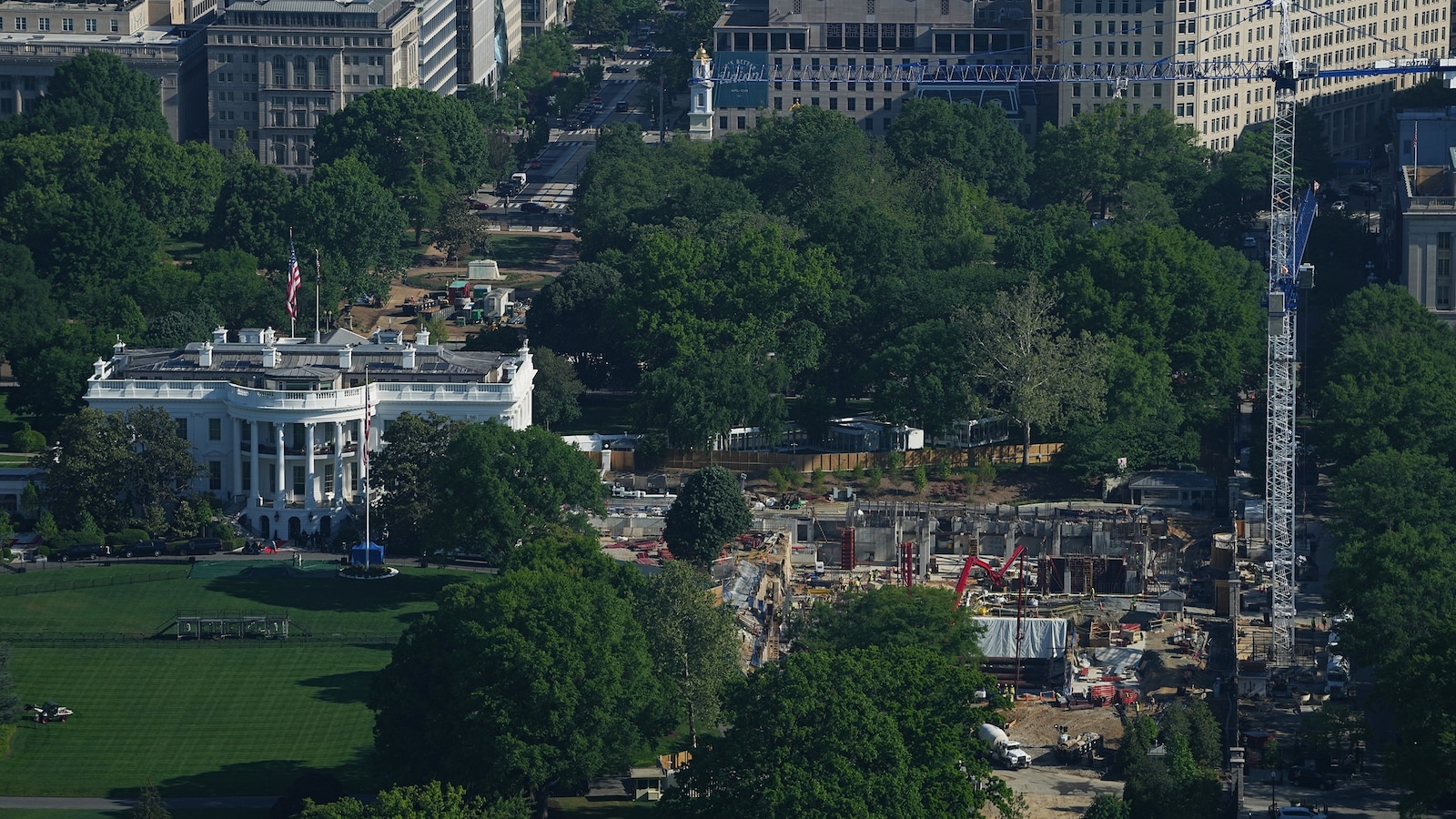
The White House ballroom project’s cost has doubled from $200 million to nearly $400 million, and Republicans in Congress are now proposing an additional $1 billion in security-related funding tied to the renovation. Trump says the higher cost reflects a larger, higher-quality project, while Democrats are criticizing the plan as a taxpayer-funded vanity project. The article is primarily political and fiscal in nature, with limited direct market impact.
This is less about a single building project and more about a durable shift in how federal discretionary spending can be rerouted through security and emergency framing. If Congress blesses a separate security line item, it creates a template for moving politically sensitive capital work from the normal appropriations process into a much more opaque bucket, which is structurally favorable for contractors with classified-facility, blast-hardening, and perimeter-security exposure. The second-order impact is that the spend may be front-loaded into design, site prep, and specialized materials before any visible construction peak, so the market reaction should anticipate procurement rather than ribbon-cutting.
The clearest winners are not broad construction firms but niche suppliers tied to secure infrastructure: ballistic glass, controlled-environment HVAC, access control, surveillance, and modular secure interiors. A meaningful slice of the budget could leak into subcontractors and distributors rather than headline primes, which often leaves the pure-play security and specialty material names underappreciated until awards are announced. On the loser side, the political blowback increases the odds that parallel federal renovation and security projects become campaign liabilities, making future funding noisier and slower even if this one passes.
The key risk is timing: the project is an election-cycle story now, but actual procurement may stretch over quarters, while litigation or appropriations fights could delay cash flow recognition. If Republicans narrow or lose control, the proposed funding path could be scaled back materially, and that would hit anything trading on a near-term order surge. Conversely, if the administration successfully bundles the spend into broader security appropriations, this becomes a year-plus revenue stream rather than a one-off headline.
Consensus is likely underestimating how much of the economic value accrues to a small set of specialized vendors rather than to general contractors. The more interesting trade is to own the “security capex” basket and fade names that look levered to the project but would actually see limited margin capture after subcontracting and compliance costs. The best asymmetry is in companies that can sell into both federal hardening and broader critical-infrastructure refresh cycles, because this event may be the political catalyst that normalizes those budgets for 2026 and beyond.
AI-powered research, real-time alerts, and portfolio analytics for institutional investors.
Request DemoOverall Sentiment
neutral
Sentiment Score
-0.10
