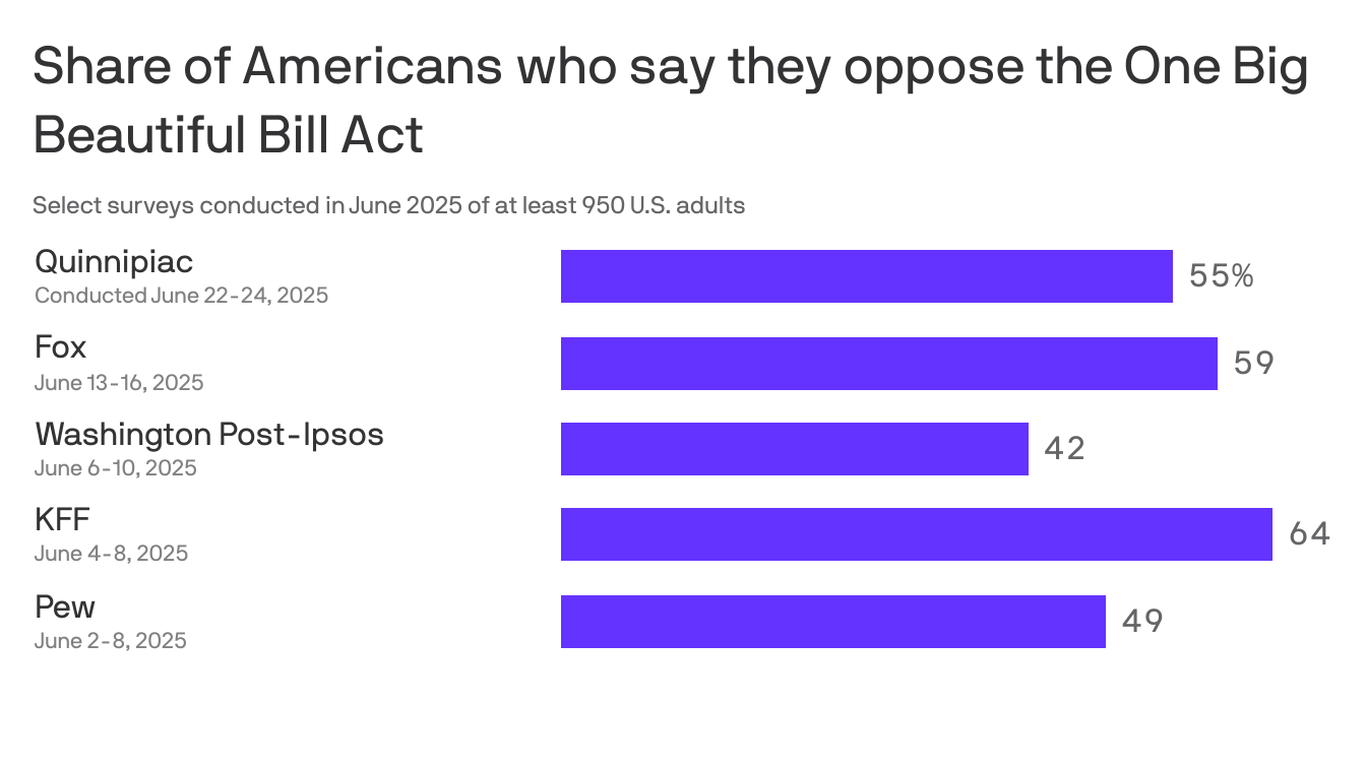
A major Republican tax and spending bill faces widespread public disapproval, with multiple polls indicating majority opposition (e.g., Quinnipiac: 55% oppose vs. 29% support). While some specific provisions, such as Medicaid work requirements, show mixed public support, overall favorability significantly declines when potential negative impacts, like the Congressional Budget Office's projection of over 10 million losing health coverage, are highlighted. This broad unpopularity, compounded by internal GOP friction and uncertainty regarding the bill's final legislative form, signals substantial political hurdles for its passage and implementation.
The proposed Republican tax and spending bill faces significant headwinds, underscored by broad public disapproval and a strongly negative sentiment score (-0.7). Polling data consistently shows majority opposition, with a Quinnipiac poll finding 55% of voters against the bill versus 29% in support. While specific provisions like Medicaid work requirements and tax cuts for low-to-middle income earners show divided or even popular support, overall favorability erodes dramatically when potential negative consequences are introduced. For instance, support plummets when voters are informed of the Congressional Budget Office's projection that the House version would lead to over 10 million people losing insurance coverage. This legislative initiative is further complicated by internal GOP friction, with disagreements between the House and Senate on the bill's final form and public opposition from key Republican senators. The bill's potential to increase the budget deficit, a key point of criticism from figures outside of government, adds another layer of risk, contributing to the bill's uncertain and contentious path forward.
AI-powered research, real-time alerts, and portfolio analytics for institutional investors.
Overall Sentiment
strongly negative
Sentiment Score
-0.70
