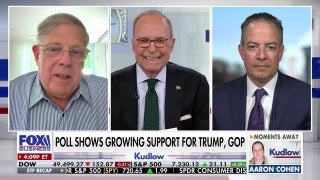
A Harvard-Harris poll of 2,745 registered voters shows a 50-50 split on the congressional race, while respondents favor Trump and Republicans on the economy 53% to 47% and believe the U.S. is winning on Iran 74% to 26%. The article argues Democrats are seen as weaker on open borders and voter ID, with 58% saying Democrats favor open borders and 65% saying they oppose voter ID requirements. The piece is largely political commentary and polling analysis, implying limited direct market impact.
The market implication is not that the headline political direction is suddenly obvious; it’s that the modal fear trade around a “Democrat wave” is becoming more crowded than the underlying polling would justify. That matters because positioning in rates-sensitive defensives, clean-energy proxies, and “Trump beneficiary” cyclicals may already be partially priced off a consensus that is more one-sided than the data. If the election odds remain close into the next 6-10 weeks, the second-order effect is a volatility regime shift: implied vol in policy-sensitive sectors can stay elevated even if spot prices drift sideways, creating better entry points for structured longs than outright cash exposure.
The most important cross-asset read-through is policy optionality. A market that increasingly assumes tighter borders, harder Iran policy, and more pro-growth fiscal rhetoric tends to support domestic industrials, defense, and selective energy, while pressuring areas that rely on regulatory easing under a Democratic scenario. The flip side is that any re-acceleration in inflation or a geopolitical shock can quickly flip this from a growth-positive narrative into a higher-yield, higher-risk-premium regime that hurts long-duration equities and small-cap breadth.
The contrarian point is that broad election consensus is usually wrong because markets overfit to media narrative and underweight turnout/elasticity among independents. If sentiment is currently underpricing a closer-to-even congressional outcome, the cleanest trade is not a massive outright Trump beta basket, but a barbelled expression: own beneficiaries that do well in either a divided government or a policy-right shift, while fading the most crowded anti-Trump shorts. The timing window is months, not days; the catalyst is polling drift plus debate/VP-cycle confirmation, with the main reversal risk being a late deterioration in consumer data that re-centers the election on affordability rather than ideology.
AI-powered research, real-time alerts, and portfolio analytics for institutional investors.
Request DemoOverall Sentiment
mixed
Sentiment Score
0.15
