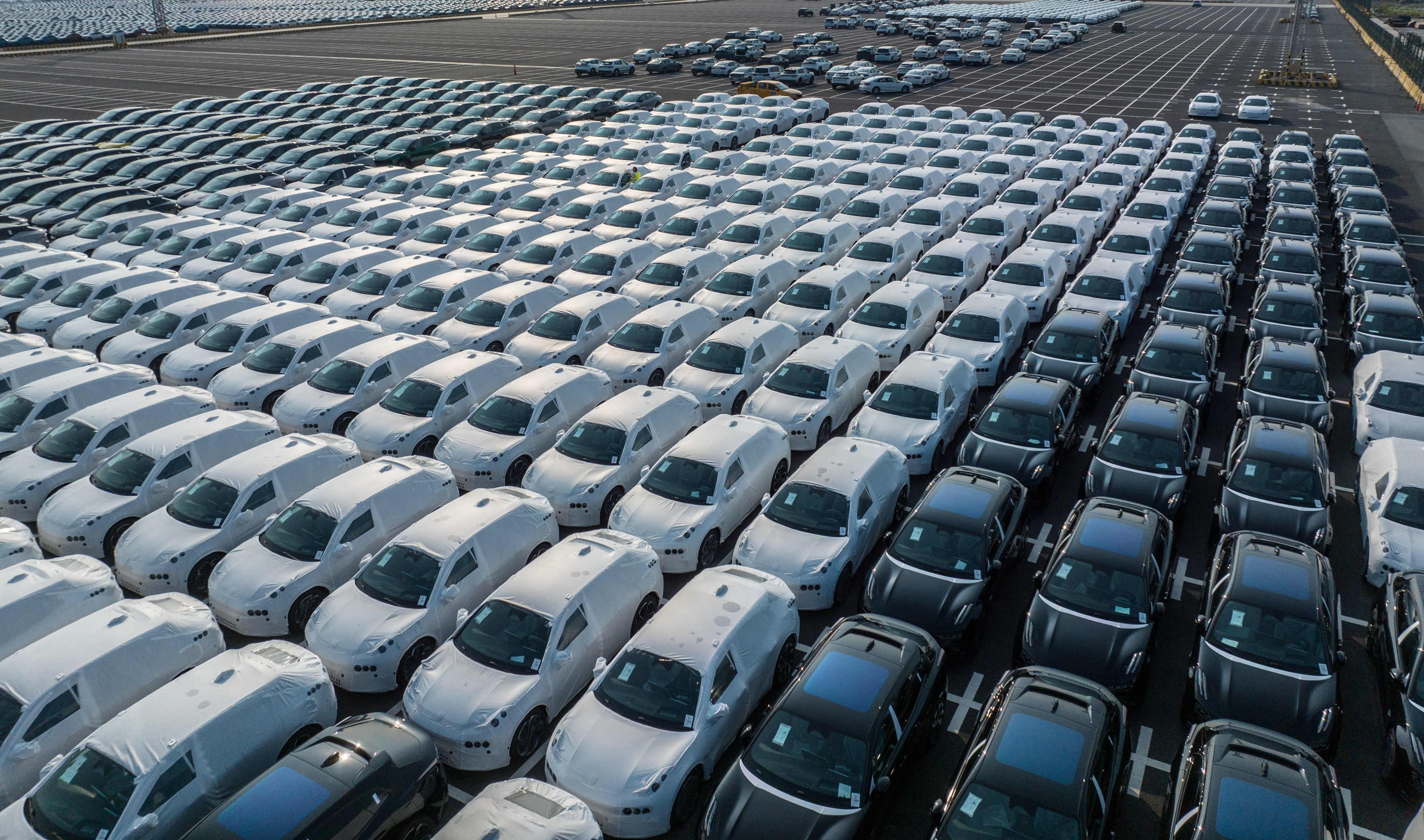
President Donald Trump attributed strength in the U.S. auto industry to tariffs and rollbacks of environmental regulations and indicated he would be open to Chinese automakers establishing plants in the United States. The remarks underscore a pro-manufacturing, deregulatory stance that could influence future trade, investment and regulatory expectations for automakers and suppliers, though the statements are political commentary rather than concrete policy enactments.
Market structure: Tariff protection + environmental rollback is a net positive for legacy US OEMs (F, GM, STLA) and domestic suppliers (NUE, STLD) because it raises import-adjusted prices and cuts compliance costs; a tariff in the 5–15% range would mechanically improve US OEM mix-adjusted margins by ~100–300bp over 12 months assuming pass-through. Imported EV challengers and foreign suppliers (NIO, LI, BYDDY, Tier-1 global parts players) are the natural losers if access is restricted or costs rise, while consumer demand may shift toward domestically produced vehicles if price gaps widen.
Risk assessment: Tail risks include rapid retaliatory tariffs (auto parts, semiconductors) or state-level legal/consumer pushback that reverses rollbacks; low-probability but >5% event is broad trade escalation that raises input costs and squeezes margins. Immediate market moves (days) will be driven by headlines; 1–6 month window is critical for policy codification; structural share shifts play out over 1–3 years as plants and supply chains reconfigure. Hidden dependency: domestic OEM benefit depends on availability of semiconductors and battery cells—tariffs don’t solve raw-material bottlenecks.
Trade implications: Tactical alpha favors overweighting US OEMs and domestic steel/mill producers while hedging exposure to high-multiple EV winners. Use short-dated option structures to capture policy-driven re-rates (3–6 month horizon) and pair trades to isolate policy sensitivity from secular EV growth. Key catalysts: formal tariff rate announcements, EPA rule publications, and any Chinese automaker US plant filings — act within 2–8 weeks of those triggers.
Contrarian angles: Consensus assumes protectionism is pure benefit to incumbents; overlooked is that tariffs can raise OEM input inflation and accelerate onshore investment by Chinese EVs which compress long-term pricing power. Historical parallel: 2002–2008 protectionist cycles initially helped steel/millers but later increased competition once capacity shifted; if Chinese firms open US plants within 12–36 months, incumbents may face margin erosion despite short-term gains. Unintended consequence: accelerated localization can shorten the policy window and flip winners into losers within 18–36 months.
AI-powered research, real-time alerts, and portfolio analytics for institutional investors.
Request DemoOverall Sentiment
mildly positive
Sentiment Score
0.30
