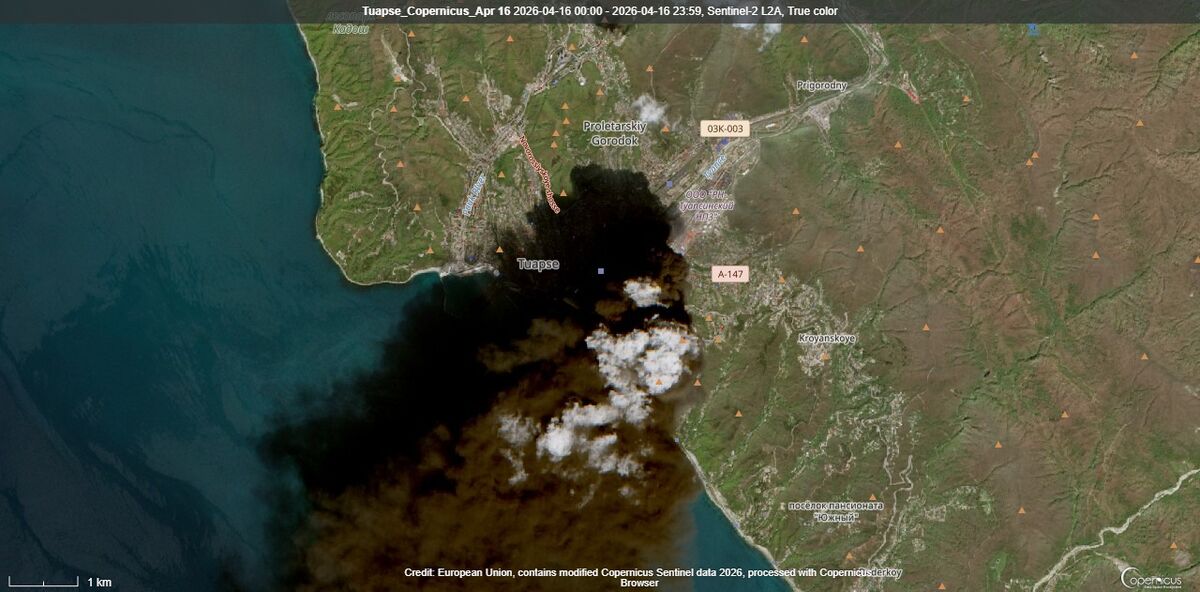
A large fire at Russia’s Tuapse marine terminal was extinguished four days after a Ukrainian drone attack, with damage extent still unconfirmed by Russian officials. The firefighting effort involved more than 150 people and 49 pieces of equipment, underscoring disruption at a Black Sea energy facility. The event is negative for local energy infrastructure but has limited directly quantified market impact in the report.
The immediate market signal is not the fire itself but the demonstrated reach of low-cost drone strikes into hardened energy logistics nodes. That raises the expected discount rate on Russian export reliability: even if headline volumes look intact, buyers will price in more schedule slippage, higher insurance, and more precautionary inventory holding. The bigger second-order effect is on regional arbitrage rather than outright global supply — disruptions at one Black Sea node can re-route barrels, tighten prompt product balances in nearby markets, and lift freight and prompt differentials before they meaningfully move benchmark crude.
For energy markets, this is most bullish in the near term for volatility and the complex, not necessarily flat price. Refined products and shipping tend to react faster than Brent because they are the first place where physical frictions show up; that favors names with exposure to crack spreads, tanker rates, and storage optionality. Over weeks to months, repeated attacks would force Russian operators to spend on redundancy and air defense, effectively turning maintenance capex into a recurring tax on export capacity.
The contrarian view is that the market may overestimate permanence. Russia has shown it can restore damaged energy infrastructure faster than western sanctions models assume, and one isolated outage does not prove sustained throughput loss. If attacks remain episodic rather than systematic, the trade becomes a volatility event, not a structural supply shock, and the premium in product and shipping assets could fade within days once flows normalize.
The main tail risk is escalation: if Ukraine successfully compounds strikes on multiple Black Sea or refinery assets, the bottleneck shifts from local disruption to export-chain fragility, which would be materially more supportive for non-Russian barrels and for any asset tied to seaborne product tightness. The key catalyst window is the next 1-4 weeks as the market watches whether repair, rerouting, and military adaptation compress the impact or whether operational downtime becomes recurring.
AI-powered research, real-time alerts, and portfolio analytics for institutional investors.
Request TrialOverall Sentiment
mildly negative
Sentiment Score
-0.20
