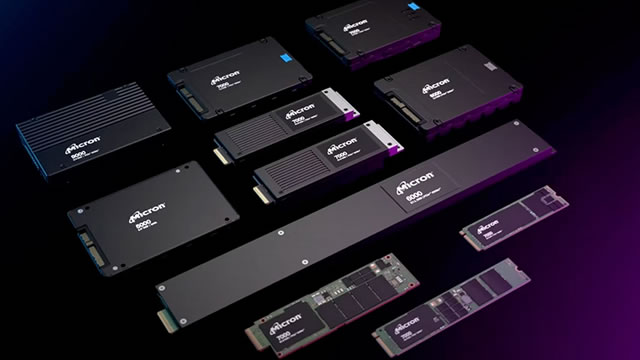
Micron (MU) is maintained as a cautious long despite recent volatility, with AI-driven demand supporting the outlook. Its strategic customer agreements now total $100B in minimum contracted revenue and $22B in commitments, improving margin visibility and reducing cyclicality. The company expects DRAM and NAND supply-demand conditions to stay tight beyond 2027, with the memory cycle unlikely to peak before 2028.
The investable change here is not simply “AI demand is strong”; it is that MU is converting a historically cyclical memory business into something closer to a quasi-contracted supply model. That should compress the discount rate applied to forward earnings, because a larger share of revenue is now visible through the next budget cycle and the market can underwrite higher normalized FCF without assuming a peak-margin year next quarter. The first-order winner is MU equity; the second-order winner may be MU credit, where tighter spread behavior is plausible if investors begin treating contracted revenue as a partial cushion against the usual downcycle drawdowns.
The bigger implication is competitive: if MU can hold pricing and allocation discipline longer, weaker balance-sheet peers with more spot exposure will feel the squeeze first. That matters for WDC and any remaining merchant-memory channels, because a prolonged tight market forces customers to prioritize supply security over lowest price, which can reinforce share concentration among the best-capitalized vendors. The flip side is that “tight through 2027/2028” also invites capacity additions; if hyperscaler demand normalizes or AI server build rates slow, the market could shift from scarcity to oversupply very quickly once new wafers hit.
Catalyst path matters: over the next 1-3 months, the stock should react less to macro semis sentiment and more to whether MU can reaffirm contract coverage and margin durability on the next print. Over 6-18 months, the key risk is that the market overpays for a long cycle that is actually just a longer inventory pipeline. The contrarian view is that the memo’s optimism may already be partially in the price; what would break the thesis is any cut to AI memory demand, weaker pricing discipline from Samsung/SK Hynix, or evidence that contract economics are fixed-price rather than genuinely margin-accretive.
AI-powered research, real-time alerts, and portfolio analytics for institutional investors.
Request DemoOverall Sentiment
mildly positive
Sentiment Score
0.35
Ticker Sentiment
