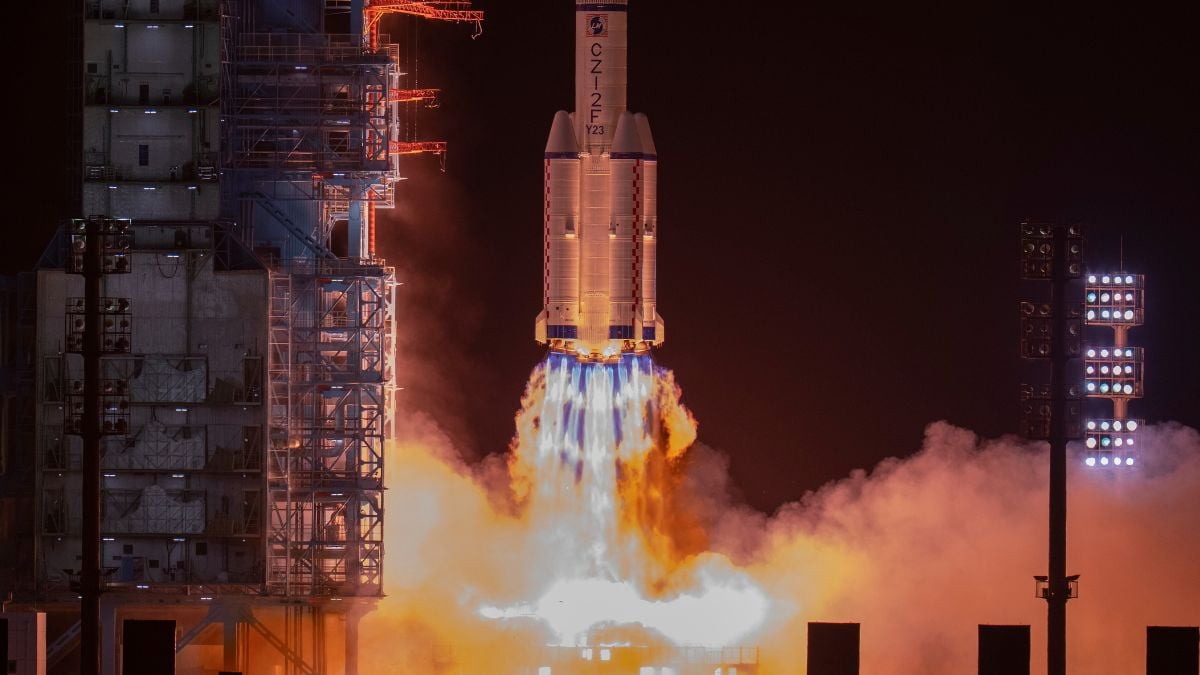
China successfully launched and docked the Shenzhou-23 crewed spacecraft with Tiangong about 3.5 hours after liftoff, advancing its plan to land astronauts on the Moon before 2030. The mission includes a planned one-year orbital stay for one crew member, a first for China and a key test of long-duration human spaceflight capabilities. The article is strategically significant for China's space program, but it is primarily factual and is unlikely to have immediate market impact.
This is less a single-launch story than a signal that China is converting its space program from prestige infrastructure into an operating system for long-duration human spaceflight. The key second-order effect is not the docking itself, but the accumulation of reliability data around life-support, radiation management, and crew endurance under a year-long mission profile—capabilities that are directly transferable to a lunar sortie architecture and eventually to cislunar logistics. That shifts the market focus from headline launches to procurement, subsystem validation, and mission cadence, which is where the economic moat will actually form.
The most interesting competitive dynamic is that China is building an autonomous end-to-end stack while the West remains more fragmented across NASA primes, commercial launch, and station services. Over the next 12-24 months, that favors Chinese aerospace and defense contractors tied to propulsion, avionics, thermal control, and environmental systems, while pressuring global incumbents that rely on ISS-adjacent collaboration or assume Western dominance in manned space. It also creates a geopolitical spillover: a credible Chinese lunar timeline raises the strategic value of dual-use space assets, boosting spending on surveillance, comms resilience, and launch availability across the U.S. and allied defense ecosystems.
The main risk is execution decay disguised as progress: year-long missions increase failure surfaces nonlinearly, so one life-support issue or crew-health anomaly could reset timelines by 6-18 months and dent confidence in the 2030 lunar goal. Near term, the catalyst path is asymmetric: success in the one-year orbit test supports a re-rating of China space suppliers and adjacent defense names; failure likely hits sentiment first, then funding intensity. The contrarian view is that the market may underprice the industrialization angle—this is not just a moon race, it is a systems-integration procurement cycle, and those cycles tend to create the biggest winners in subsystems rather than the most visible headline contractors.
AI-powered research, real-time alerts, and portfolio analytics for institutional investors.
Request DemoOverall Sentiment
neutral
Sentiment Score
0.10
Ticker Sentiment
