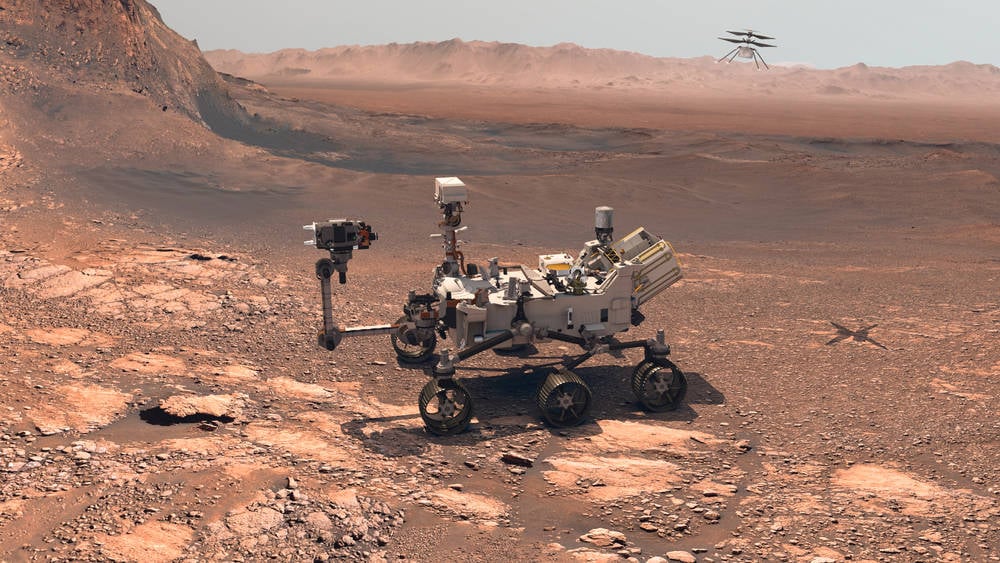
NASA's Jet Propulsion Laboratory used Anthropic's Claude vision-language model to pre-plan roughly a 400-meter traverse for the Perseverance rover, producing Rover Markup Language commands that engineers validated and slightly edited in simulation (checking over 500,000 telemetry variables) before uplinking routes executed on Martian sols 1,707 and 1,709 (Dec. 8 and Dec. 10, 2025). The demonstration—performed with human oversight and AutoNav adjustments—shows operational gains for AI in mission planning, with Anthropic and JPL saying Claude can halve route-planning time (baseline unspecified), a constructive but limited near-term commercial signal for AI vendors servicing robotics and aerospace customers.
Market structure: The immediate winners are compute and imagery suppliers — NVIDIA (NVDA) for datacenter GPUs, AWS (AMZN), Microsoft Azure (MSFT) and Google Cloud (GOOG) for inference/validation, and satellite-imagery firms like Maxar (MAXR) that feed high‑resolution terrain data. Labor-intensive route‑planning and boutique robotics consultancies are at risk of margin compression as generative vision-to-action pipelines cut planning time by ~50% (per JPL claim); pricing power shifts toward firms that control models, data, and specialized silicon. Cross‑asset: stronger tech capex lifts semiconductor equities and commodity demand for copper/rare metals modestly; duration-sensitive assets (long bonds) could face higher supply if corporates accelerate capex, while FX may see incremental USD strength into tech capex cycles. Risk assessment: Tail risks include regulatory constraints (export controls or safety certification for autonomy) within 6–18 months, an operational failure that triggers stricter validation regimes, or a GPU shortage that spikes costs >20% and compresses gross margins. Immediate (days): limited market reaction; short (weeks–months): cloud providers and chip suppliers’ guidance and order books will move sentiment; long (quarters–years): durable reallocation of R&D budgets into integrated vision-action stacks. Hidden dependencies: access to labeled planetary/terrestrial datasets, simulator fidelity, and on‑premise vs cloud inference economics; catalysts include NVIDIA earnings, NASA procurement notices, and EU/US AI regulation milestones. Trade implications: Tactical long positions: NVDA and cloud leaders benefit most; imagery providers (MAXR) are asymmetric picks if backlog growth >10% YoY. Use relative trades rather than naked conviction: pair long NVDA vs short AMD (AMD) to express datacenter GPU dominance, and prefer covered-call or call‑spread structures to control premium. Options: buy 3–6 month call spreads 10–20% OTM on NVDA or MSFT to capture re‑rating while capping cost; consider 9–12 month LEAPs on MAXR for optionality into sustained imagery demand. Sector rotation: overweight Semis/Cloud/Space Data, underweight manual services and small robotics integrators; rebalance on guidance or +/-15% moves. Contrarian angles: Consensus will overstate immediate revenue for AI planning but understate structural demand for high‑quality imagery and validated simulation stacks — MAXR and defense primes (LMT, NOC) may be underappreciated for recurring strong demand in 12–36 months. The market may be overbuying pure‑play model vendors without control of compute/data (+risk of regulation), so avoid or short software-only names lacking unique datasets. Historical parallel: GPS/avionics automation took a decade to generate recurring revenue after technical proof; expect a similar multi‑year cadence and episodic volatility. Unintended consequence: liability and certification markets will grow (insurance, compliance vendors), creating new investable niches and cost lines for adopters.
AI-powered research, real-time alerts, and portfolio analytics for institutional investors.
Request DemoOverall Sentiment
mildly positive
Sentiment Score
0.30
