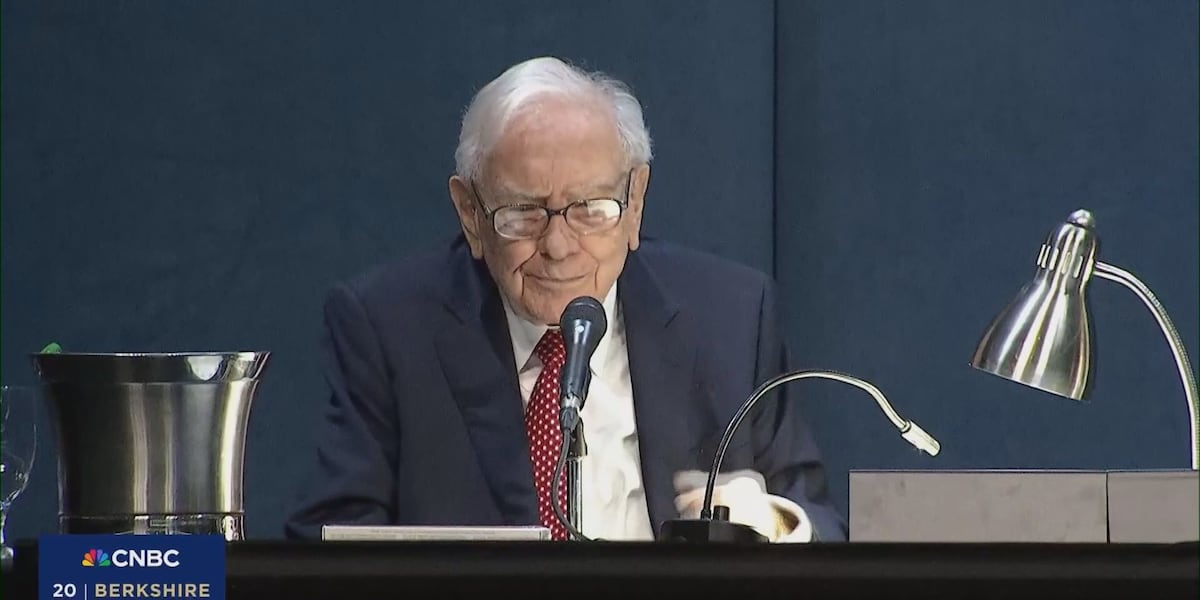
Berkshire Hathaway's annual shareholder meeting drew a smaller crowd this year, with attendees estimating attendance was roughly one-third lower than last year as Greg Abel led the event for the first time. Longtime shareholders attributed the softer turnout to Warren Buffett's absence, noting that people historically came as much to see Buffett as to hear from Berkshire. Official attendance figures have not yet been released, and the change appears more symbolic than financially material.
The attendance drop matters less as a one-day sentiment read and more as an early signal that Berkshire’s “Buffett premium” is being re-priced into a “capital allocation utility” multiple. That transition usually compresses the retail/FOMO component first, but institutional ownership can be stickier if operating earnings and buyback discipline remain intact. In other words, the valuation risk is not from a broken franchise; it is from a slower, less charismatic distribution of the same underlying cash flows.
Second-order, lower meeting draw is a mild negative for adjacent Omaha ecosystems and for the quasi-annual marketing halo that has historically helped Berkshire source deals, recruit managers, and reinforce partner confidence. That halo effect is most relevant for the non-insurance operating subsidiaries: the less the company feels like a cult object, the more it becomes a measured conglomerate with fewer embedded optionality bids. Over months, that can slightly reduce the premium investors assign to “ability to deploy capital well” versus a pure sum-of-the-parts framework.
The key catalyst is whether Abel can convert a governance transition into evidence of continuity rather than change. If capital allocation remains disciplined and operating managers are showcased effectively, the crowding concern fades quickly; if not, the market could start to discount Berkshire on a lower growth/less narrative multiple even if fundamentals are unchanged. The risk window is mostly 3-12 months, not days: it will show up through relative underperformance versus quality large-cap financials and industrials if the new regime fails to generate fresh buyback or redeployment conviction.
Contrarian view: the market may be over-indexing on the optics of a smaller event while underpricing the benefit of a less personality-dependent Berkshire. A lower-key annual meeting can actually help normalize the stock as a compounding vehicle rather than a memorabilia asset. If Abel is effective, the absence of Buffett as a crowd magnet may be a feature, not a bug, because it shifts attention from celebrity to process.
AI-powered research, real-time alerts, and portfolio analytics for institutional investors.
Request DemoOverall Sentiment
neutral
Sentiment Score
-0.05
Ticker Sentiment
