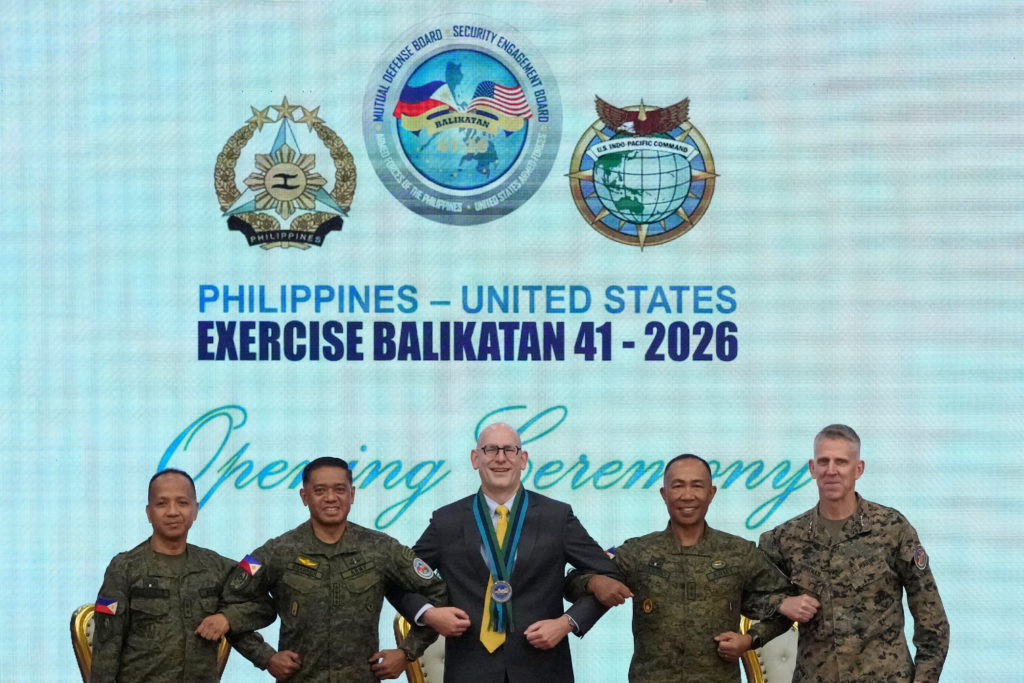
More than 17,000 U.S. and Filipino personnel are participating in Balikatan, one of the largest annual combat drills, lasting nearly three weeks and expanding to include Japan and Canada. The exercise features live-fire maneuvers in areas near the South China Sea and Taiwan Strait, drawing objections from China and highlighting rising regional military tensions. Japan is deploying a 1,400-member contingent, and nearly 10,000 U.S. troops are involved, underscoring Washington’s commitment to Indo-Pacific deterrence.
The underappreciated signal is not the exercise itself, but the institutionalization of a wider anti-coercion coalition in the first island chain. Japan’s fuller participation materially raises the ceiling on allied interoperability around the South China Sea/Taiwan axis, which should incrementally compress the perceived probability of a limited fait accompli scenario over the next 6-18 months. That matters because deterrence is increasingly being priced not as a binary war/no-war outcome, but as a higher baseline of persistent readiness that keeps regional procurement and rotational deployments elevated.
The second-order beneficiary set is broader than prime contractors. This kind of drill supports demand for ISR, drones, coastal defense, C2 software, secure comms, maritime logistics, and MRO capacity in allied bases, especially across Japan, Guam, and the Philippines. The biggest near-term commercial effect is likely on suppliers tied to distributed maritime operations and attritable systems rather than legacy platforms; those categories should see faster budget conversion and less political friction than headline shipbuilding or fighter programs.
Risk is mostly in the timing mismatch: military signaling can be hawkish for months without changing the actual conflict probability today. The main reversal catalyst would be a regional diplomatic thaw or a U.S. strategic de-emphasis if Middle East commitments intensify, but that looks more like a tactical pause than a structural unwind. The tail risk is an incident at sea during or shortly after the exercise, which would accelerate allied procurement and push Asian defense multiples higher, even if broader markets initially de-risk.
Consensus may be underestimating how much this benefits non-U.S. Asian defense vendors and systems integrators, not just U.S. primes. The market often treats Indo-Pacific deterrence as a generic defense beta trade, but the real alpha is in companies exposed to maritime surveillance, drones, missiles, and interoperability software where incremental allied spend can re-rate revenue visibility. Conversely, the geopolitical premium in regional shipping and logistics is probably still too low unless confrontation frequency begins to affect route insurance or vessel scheduling.
AI-powered research, real-time alerts, and portfolio analytics for institutional investors.
Request DemoOverall Sentiment
mildly negative
Sentiment Score
-0.15
