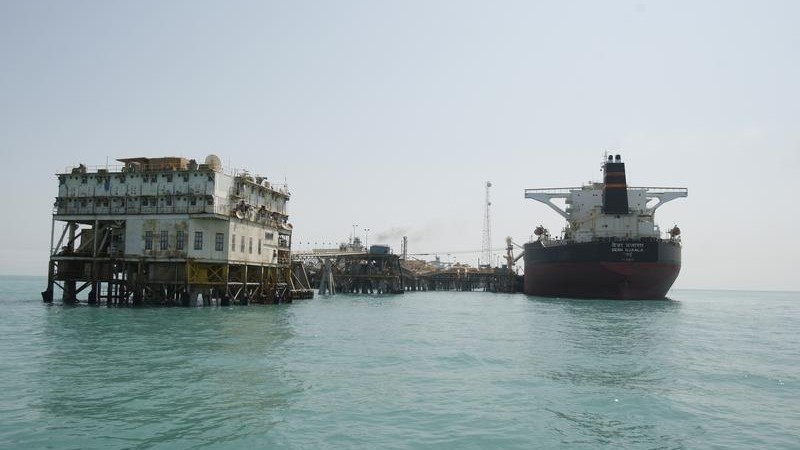
Iraq is offering discounts of up to $33.40 per barrel below official selling prices for Basrah crude that must move through the Strait of Hormuz, reflecting severe disruption to exports. Basrah Medium loading in May is priced at a $33.40/bbl discount for cargoes loaded May 1-10 and a $26/bbl discount for May 11-31, while Basrah Heavy is offered at $30/bbl below OSP. The article highlights a de facto closure of Hormuz, empty westbound tanker movements, and rising geopolitical risk to global energy supplies.
This is less a simple crude bullish headline than a temporary dislocation in the physical market structure. When a grade trades at a triple-digit discount to benchmark economics, the signal is that logistics have become more valuable than molecules: whoever can source, store, or reroute barrels earns the spread, while anyone tied to immediate Gulf delivery becomes a price-taker. The immediate beneficiaries are floating storage, non-Gulf replacement crude streams, and refiners with flexible slates; the losers are spot-dependent refiners and traders carrying Gulf exposure without transport optionality.
The second-order effect is that this kind of bottleneck usually widens time-spreads faster than outright benchmarks. Nearby cargoes should remain under pressure until the navigation regime normalizes, but deferred months may stabilize first as market participants reprice the probability that this is a duration problem rather than a permanent outage. That creates an opportunity in calendar structures: the curve can flatten even if flat price stays elevated, especially if inventories outside the region are accessible and Chinese/Indian buyers opportunistically absorb discounted barrels.
The key risk is policy-driven de-escalation, which would collapse the discount much faster than headline geopolitics suggest. If shipping lanes reopen even partially, forced sellers will rush to monetize inventories, and discounts of this magnitude can mean-revert violently within days, not weeks. Conversely, if tanker routing restrictions persist into month-end, the market may be underpricing knock-on inflation in diesel and maritime freight, which would broaden the macro shock beyond energy equities.
Contrarian view: the market may be focusing too much on the crude scarcity narrative and too little on the arbitrage reset. Deep discounts can attract opportunistic end-users, so the real trade is not outright long energy but long logistical friction and short downstream margin compression where feedstock costs remain elevated but product demand is elastic. The best expression is to own the bottleneck, not the commodity.
AI-powered research, real-time alerts, and portfolio analytics for institutional investors.
Request DemoOverall Sentiment
strongly negative
Sentiment Score
-0.70
