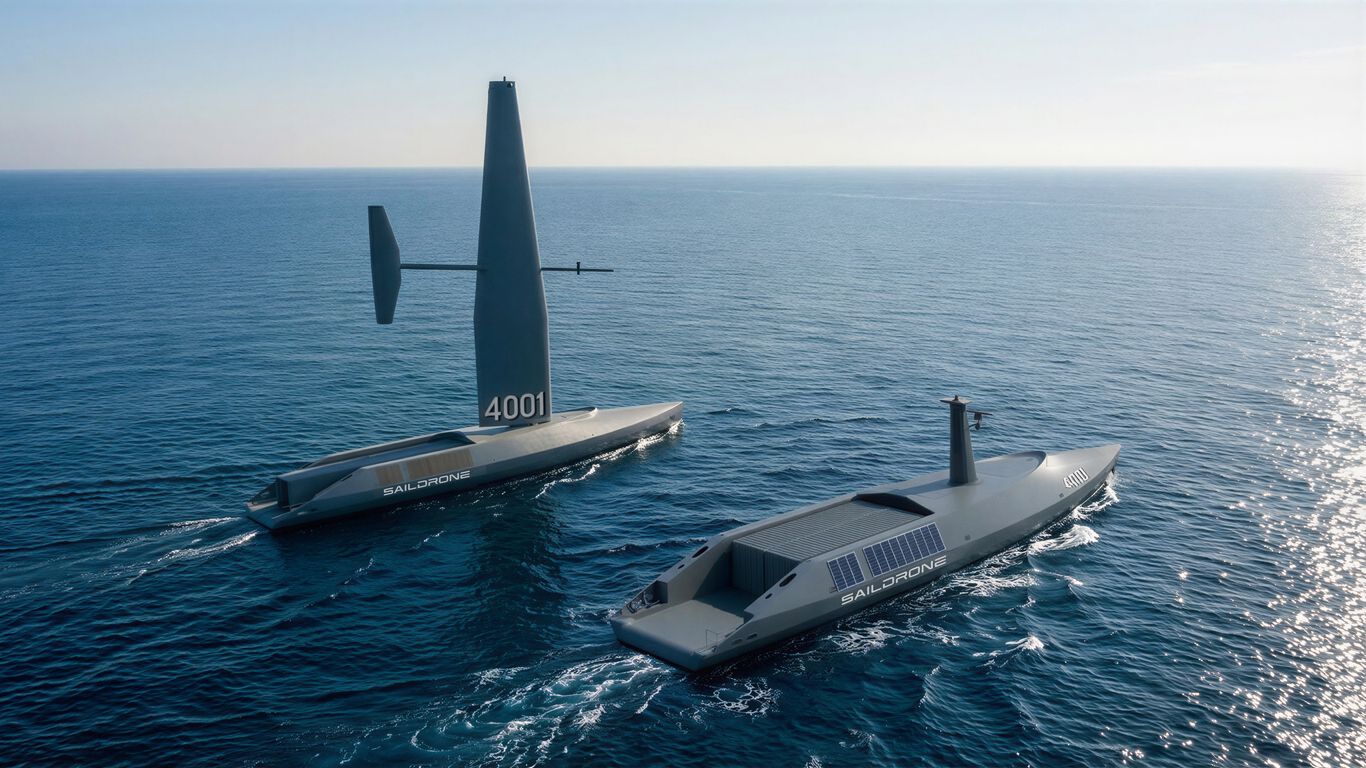
Saildrone unveiled Spectre, a 170-foot unmanned surface vessel designed for anti-submarine warfare, surveillance, and missile launches, with sea trials targeted for early 2027. The vessel is expected to travel 3,280 nautical miles and carry roughly 55,000 pounds at 25 knots, with a maximum payload near 70 metric tons. The first boat is internally funded, with construction assigned to Fincantieri in Wisconsin and a 140-foot wing to American Magic in Florida, while Lockheed-compatible systems broaden its defense relevance.
This is more meaningful for LMT than the headline partnership suggests: Saildrone’s platform being positioned as a compliant entrant for Navy unmanned surface vessel procurement increases the probability that autonomy becomes a funded capability rather than a science project. The second-order effect is that prime contractors with payloads, integration, and weapons interfaces gain leverage over pure-platform plays; if the Navy standardizes around modular ASW kits, the value migrates to mission systems, sonars, launchers, and datalinks rather than hull builders.
The near-term commercial read-through is also favorable for the defense supply chain. Aluminum fabrication, specialized marine engineering, and long-lead sensor components are likely to see incremental demand, but the real bottleneck is testing and certification, which stretches the monetization curve into 2026-2027. That long runway reduces execution risk for the prime beneficiaries while making smaller drone-vessel competitors vulnerable to a procurement cycle that rewards proven endurance and payload integration over lower unit cost.
The contrarian point is that this may be less of a platform revolution than a procurement reallocation. The Navy’s requirements are shifting toward survivability, persistence, and mission flexibility, which tends to favor incumbents with lobbying power and integration capability; a new hull alone is not enough. The market may be underpricing the chance that unmanned surface vessels become a niche adjunct to manned ASW rather than a replacement, limiting upside for pure-play autonomy names while still supporting a multi-year revenue stream for LMT and selected electronics suppliers.
Key risks are timeline slippage and policy churn: if live-fire demos or sea trials disappoint, the commercial narrative can de-rate quickly over the next 6-12 months. Conversely, European demand could accelerate if offshore infrastructure security becomes a larger budget line item, but that is a 2-3 year thesis rather than a near-term catalyst. The biggest reversal risk for LMT is if the Navy pushes architecture toward open-standards integration that commoditizes payload modules and caps margin capture.
AI-powered research, real-time alerts, and portfolio analytics for institutional investors.
Request DemoOverall Sentiment
mildly positive
Sentiment Score
0.38
Ticker Sentiment
