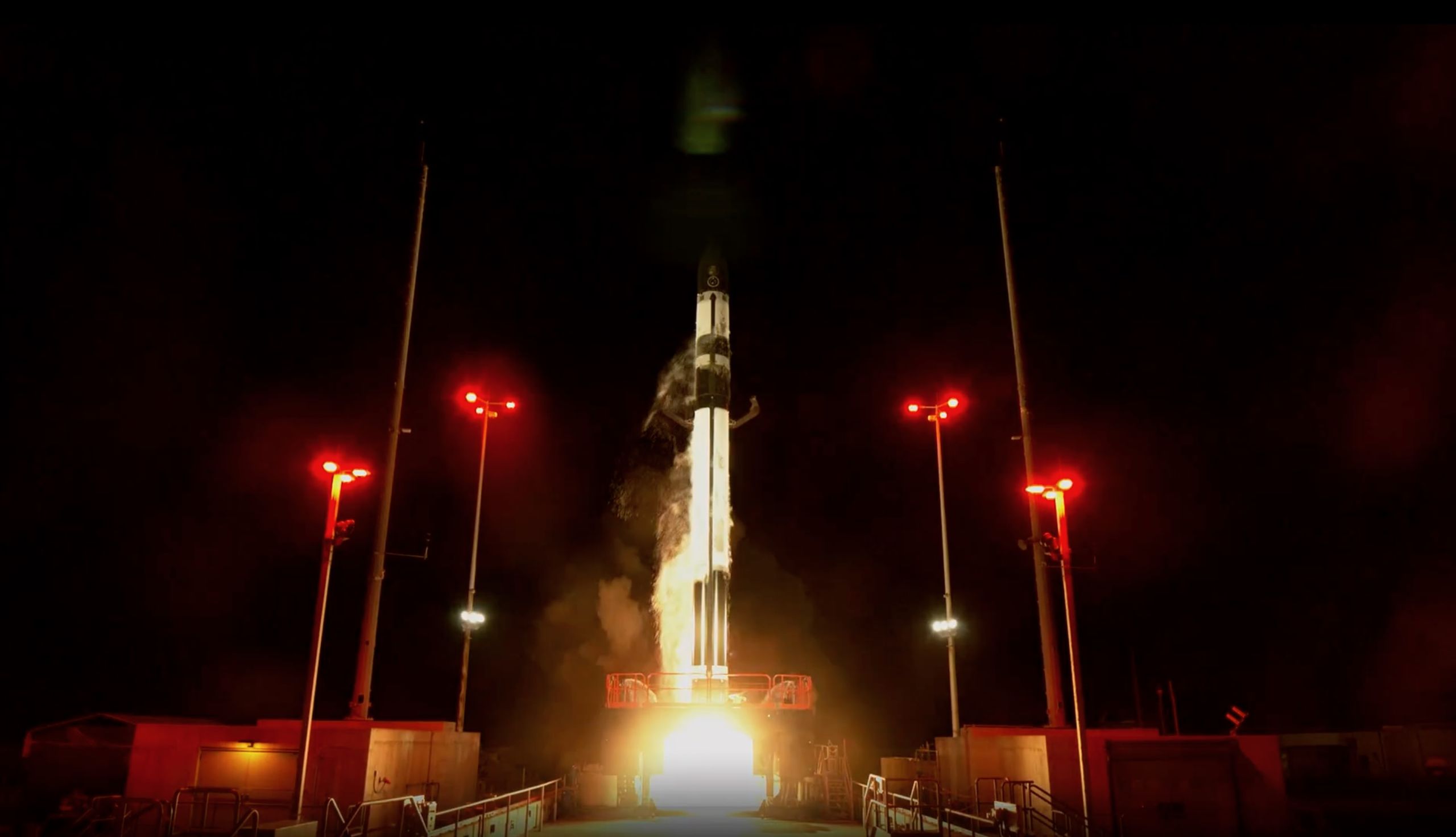
Rocket Lab successfully launched an Electron rocket from Wallops Island on Dec. 18, deploying four experimental 40-inch-by-1-inch DiskSats developed by The Aerospace Corporation with NASA funding as part of the U.S. Space Force STP-S30 mission; deployment occurred at ~550 km about 55.5 minutes after liftoff. The mission — expedited at the Space Force's request — marks Rocket Lab's 20th launch of 2025, extending its single-year launch record (previous high 16 in 2024), and signals potential operational momentum and new small-satellite form-factor capabilities (low drag, continuous Earth-facing surface) relevant to defense and Earth-observation markets.
Market structure: Rocket Lab (RKLB) is a clear near-term winner — 20 launches in 2025 and a Space Force-expedited mission point to rising DoD demand for dedicated smallsat lifts. Defense primes (LMT, NOC, RTX) and smallsat integrators (LLAP) are secondary beneficiaries via systems integration and procurement spend; legacy cubesat-component specialists may face pricing pressure if DiskSats gain adoption. Increased dedicated launch cadence signals growing supply of small-launch capacity that will compress per-launch pricing over 12–36 months unless DoD/NASA budgets expand accordingly.
Risk assessment: Tail risks include a high-profile RKLB mission failure (>20% equity drawdown), a Pentagon budget pivot or new debris/altitude regulation that curtails very-low-altitude ops, and technological underperformance of the DiskSat form factor. Immediate impact is sentiment-driven (days–weeks); contract awards and revenue recognition play out in months; technology adoption and material effects on suppliers will take 2–5 years. Hidden dependency: commercial viability hinges on sustained Space Force/NASA follow-on contracts and demonstrated lifetime at low altitudes.
Trade implications: Tactical buys are RKLB equity/options to capture cadence-driven upside and defense primes (LMT, NOC) for exposure to procurement tailwinds; consider small positions in LLAP for satellite bus exposure. Use options to size risk: sell short-dated calls after deployment excitement (IV often compresses 15–30% within 30 days) or buy 9–12 month call spreads to cap premium. Pair trades: long RKLB vs short pure-play smallsat hardware names lacking recurring DoD revenue if follow-on awards don’t materialize within 6–12 months.
Contrarian angles: Markets may overrate DiskSat as a near-term commercial game-changer — it’s experimental and niche; the bigger bet is on sustained government programs, not a swift commercial shift. Historical parallel: CubeSat hype produced many startups that failed to scale without recurring institutional contracts, suggesting selectivity matters. Unintended consequence: increased very-low-altitude ops could trigger stricter licensing and insurance costs, slowing adoption and re-pricing winners.
AI-powered research, real-time alerts, and portfolio analytics for institutional investors.
Request DemoOverall Sentiment
mildly positive
Sentiment Score
0.30
