
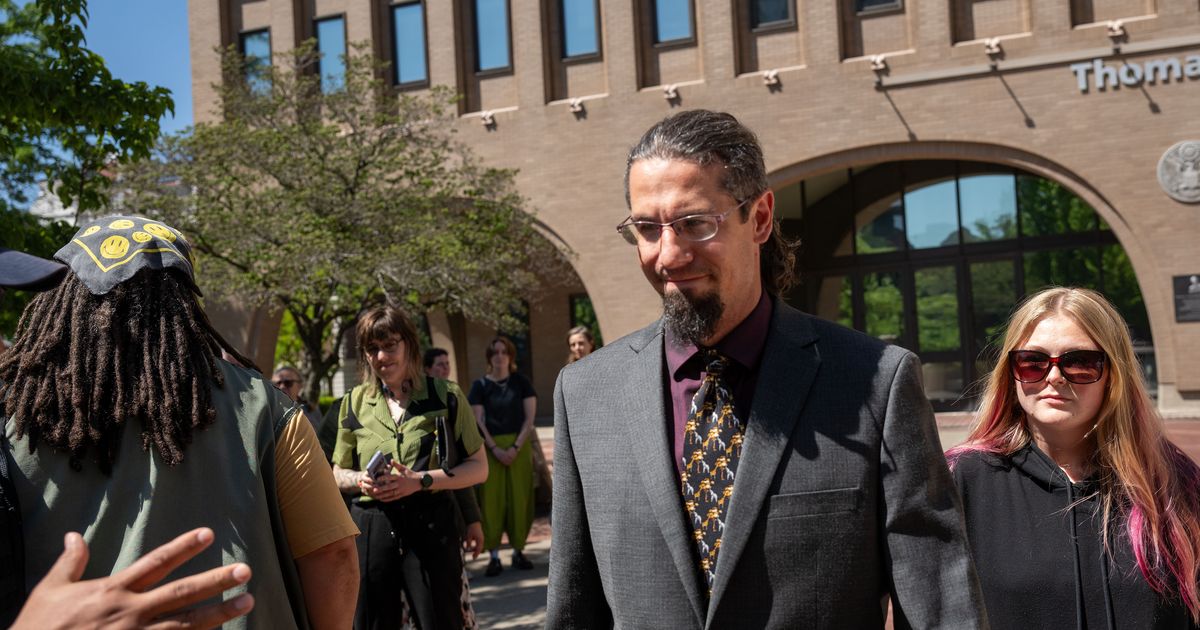
A federal jury found three Spokane protesters guilty in an ICE conspiracy case after an eight-day trial, exposing potential penalties of up to 6 years in prison each. The case centers on whether protest activity crossed into criminal conspiracy, with defense arguments emphasizing First Amendment protections and nonviolent intent. This is a notable legal and political development, but it is unlikely to have direct market impact.
This reads less like a single protest case and more like a template for broadening federal enforcement around immigration-related demonstrations. The important second-order effect is not the sentence exposure of three defendants, but the signaling value to prosecutors nationwide: the legal threshold for converting disruption into a conspiracy case now appears lower, which can meaningfully raise expected costs for activist networks, permit-heavy civic groups, and any local official who can be framed as enabling obstruction.
For ICE-linked risk, the near-term beneficiary is operational control: higher deterrence should reduce the frequency and intensity of physical blockade tactics, which lowers transport disruption risk and overtime/security costs. The bigger medium-term consequence is political, not operational — more aggressive prosecutions can harden opposition, increase turnout at flashpoint events, and shift protest behavior from visible obstruction to less predictable, decentralized actions that are harder to police but also less likely to produce headlines.
The market read-through to ICE is small in fundamental terms, but sentiment can matter if this becomes part of a broader immigration-enforcement cycle. The main upside scenario for ICE is a cleaner enforcement backdrop with fewer physical impediments and lower litigation drag; the main downside is that a nationalized protest narrative invites additional oversight, policy scrutiny, and reputational headwinds if future incidents look excessive or inconsistent across districts. The timing is weeks to months, not quarters: watch for follow-on indictments or DOJ guidance as the real catalyst.
Contrarian angle: consensus may overestimate the chilling effect on protests and underestimate the mobilization effect. If activists perceive selective prosecution, the result can be fewer participants but more committed ones, which raises tail-risk around isolated clashes rather than reducing it. That makes this more of a volatility event than a clean directional fundamental signal.
AI-powered research, real-time alerts, and portfolio analytics for institutional investors.
Request TrialOverall Sentiment
mildly negative
Sentiment Score
-0.15
Ticker Sentiment
