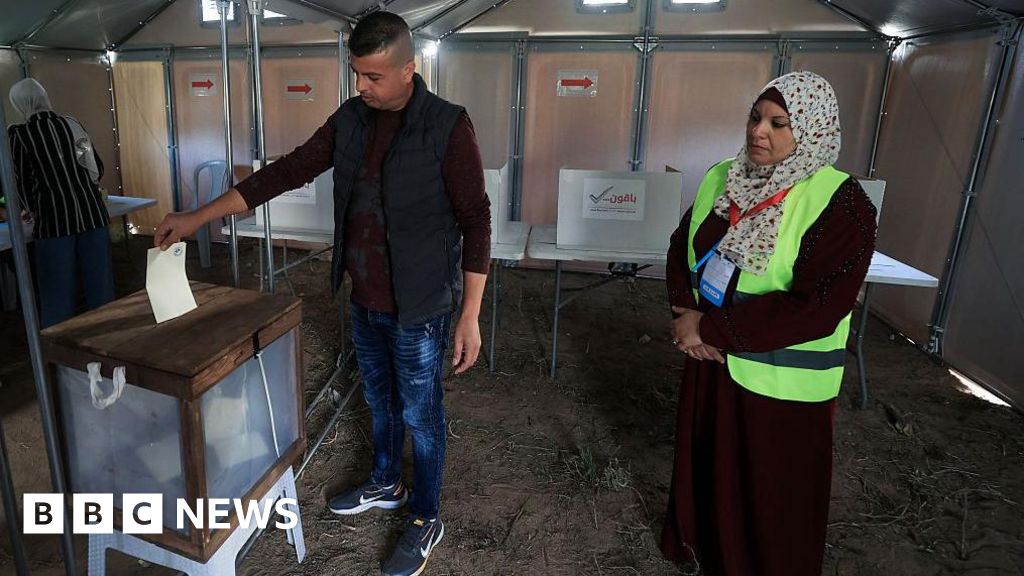
Palestinians are voting in local elections for the first time in Gaza since 2006, with polls held across the West Bank and in Deir al-Balah in central Gaza. Hamas was barred from the ballot and several factions boycotted the vote over PLO-recognition requirements, underscoring persistent political fragmentation between Hamas, Fatah, and the PA. The event is mainly a domestic political development with limited direct market impact, though it comes against the backdrop of the Israel-Hamas war and a fragile ceasefire.
This is less a clean political normalization story than a signal of institutional bifurcation: the West Bank and Gaza are moving further out of sync, which lowers the probability of a unified Palestinian negotiating counterpart for months, not days. That matters because any post-conflict reconstruction framework in Gaza now faces a governance vacuum risk premium — donors can fund physical rebuilds, but execution risk stays elevated if local legitimacy remains fragmented and security enforcement is split. The practical implication is slower-than-expected capital deployment into Gaza-related rebuilding themes and a higher chance that aid flows get conditioned on political concessions.
The more important second-order effect is for regional risk assets: a fragmented Palestinian political field reduces near-term headline risk of a broad-based diplomatic breakthrough, but it also leaves the ceasefire more brittle because there is no credible single authority to police spoilers. That increases tail risk for short, sharp escalations rather than sustained conflict, which tends to be worse for local EM sentiment than for global risk markets — a pattern where the first-order volatility fades quickly, but project finance, tourism, and cross-border logistics never fully re-rate. The market should think in terms of a 1-3 month catalyst window around any ceasefire enforcement failure, not a one-day event.
Contrarian take: the consensus may be overestimating the signaling value of the vote itself. If turnout is decent, it does not necessarily translate into governance capacity; if turnout is weak, it is not automatically a setback for markets because investors already discount low legitimacy. The real variable is whether Hamas’ relative strength in Gaza combined with Fatah weakness in the West Bank hardens the status quo enough to keep reconstruction and external funding bottlenecked for longer than expected.
AI-powered research, real-time alerts, and portfolio analytics for institutional investors.
Request DemoOverall Sentiment
neutral
Sentiment Score
-0.05
