
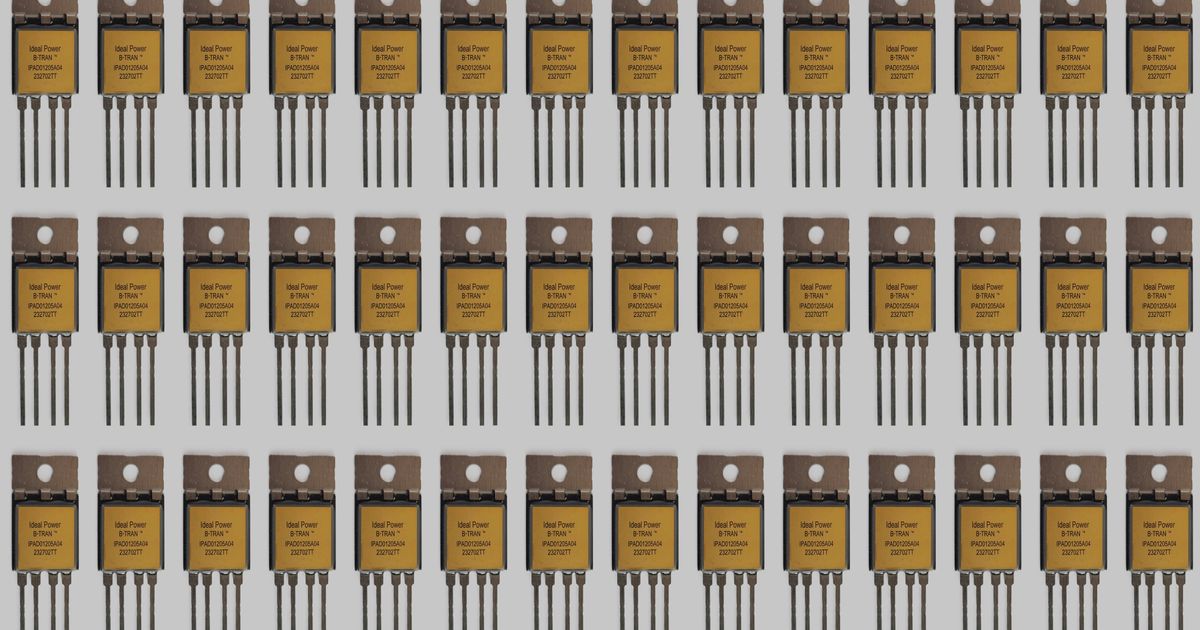
Ideal Power (NASDAQ: IPWR) closed an underwritten public offering and concurrent private placement raising roughly $14 million in gross proceeds by issuing about 4.5 million common shares (or pre-funded warrants) plus pre-funded warrants for ~0.6 million additional shares. The financing was led by the company’s largest institutional holders with insider participation, including the CEO; proceeds will fund commercialization and initial production ramp of its B-TRAN bidirectional semiconductor power switch, customer design-ins and custom development programs, with Titan Partners as sole bookrunner and WestPark Capital as financial advisor.
Market structure: The $14M financing (≈4.5M shares plus ~0.6M pre-funded warrants) shores up IPWR’s near-term commercialization push for its B-TRAN bidirectional switch, benefiting IPWR (ticker: IPWR), contract manufacturers and early design-win customers. Incumbent IGBT/MOSFET vendors face incremental competitive pressure on specific bidirectional niches, but the funds are small relative to global power-semiconductor TAM so immediate market-share shifts are limited; expect localized pricing pressure in targeted applications (EV chargers, ESS). Liquidity/dilution risk is real — watch conversion of pre-funded warrants as an overhang over the next 3–12 months.
Risk assessment: Tail risks include failed production ramp, supply-chain bottlenecks for packaging/test, or a competitor GaN/SiC partner locking key customers; each could wipe >50% of realized value. Timeline: days — elevated post-offer vol; weeks–months — design-win announcements and partner production milestones; 12–36 months — revenue/market-share outcomes. Hidden dependencies: reliance on strategic manufacturing partners and repeat customer wins; insider participation reduces but does not eliminate need for follow-on capital. Catalysts: signed customer POs, first commercial shipments (within 6 months), and strategic partner capacity commitments.
Trade implications: For risk-tolerant investors, modestly sized directional exposure to IPWR is attractive on binary design-win upside; favor capital-limited structures (bull-call spreads or long-dated calls financed by short near-term calls). Relative value: overweight power-conversion innovators vs broad semiconductor benchmarks; avoid levering short positions against large diversified suppliers. Enter after 5–15% post-offer volatility cools; target 6–12 month horizon and trim on confirmed production shipments.
Contrarian angles: Consensus may underweight the execution complexity — small $14M raise often precedes further dilutive raises if design-in cadence slips, so upside is conditional, not guaranteed. The market may underprice insider-led financings when insiders participate meaningfully; judge by concrete milestones (first paid shipment, ≥2 paying customers) rather than press-release rhetoric. Historical parallels: small-cap hardware firms often re-rate on first commercial volume; conversely, repeated micro-raises signal capitalization failure and permanent dilution risk.
AI-powered research, real-time alerts, and portfolio analytics for institutional investors.
Request TrialOverall Sentiment
moderately positive
Sentiment Score
0.35
Ticker Sentiment
