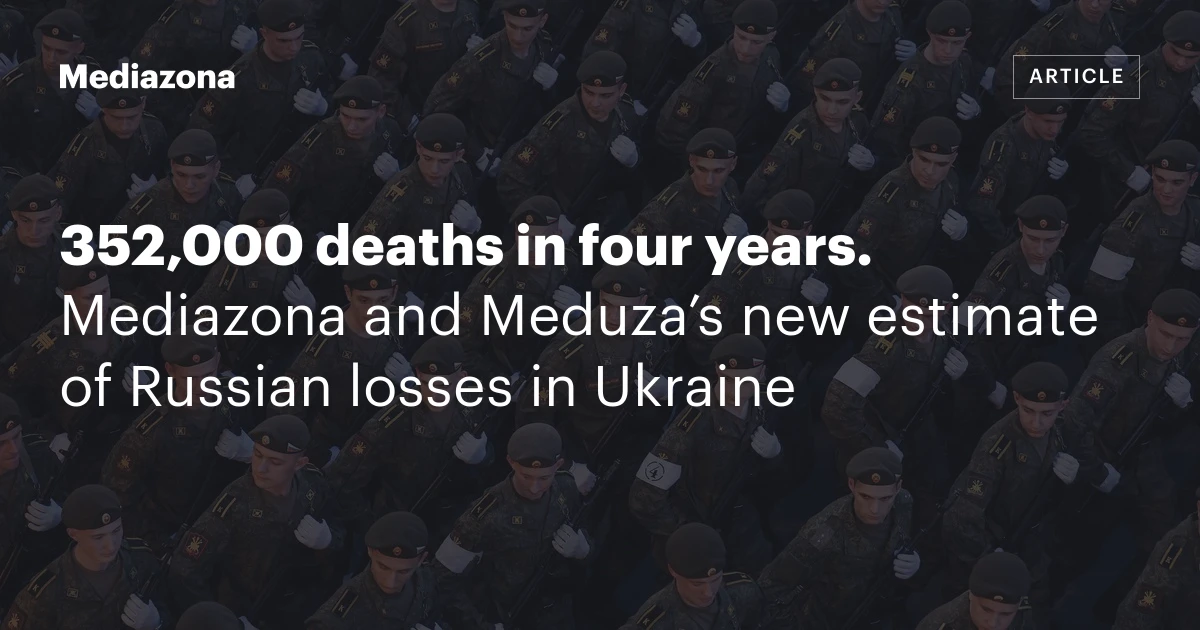
Mediazona and Meduza revised their estimate of Russian military deaths in the war against Ukraine to 352,000 male Russian citizens aged 18 to 59 through end-2025, including about 261,000 regular fatalities and roughly 90,000 late/court-confirmed deaths. The update highlights a new wave of court-ordered missing/dead declarations and delayed registrations, with 52,000 excess probate cases and 86,500 excess court claims identified. The article is primarily a war-loss and legal-data methodology update rather than a direct market-moving event.
The real market signal here is not the headline casualty count; it is the institutionalization of delayed death recognition. That implies a persistent data shadow over Russian mobilization metrics for the next 6-12 months, meaning any apparent stabilization in manpower losses is likely to be revised higher with a lag. For policymakers and investors, the second-order effect is that Russia’s labor and fiscal strain is probably undercounted in near-term consensus models, especially where analysts anchor on monthly recruitment or battlefield attrition snapshots.
The most important operational consequence is on the supply of coercive manpower, not just infantry. If the state is increasingly relying on court-mediated death declarations, that usually means the system is absorbing a larger share of missing/undocumented fatalities, which raises frictions in unit replacement, benefits administration, and local political tolerance. Over the next 3-9 months, that can force either higher compensation outlays or more aggressive recruitment incentives, both of which are mildly inflationary and fiscally negative even before considering broader war spending.
From a market perspective, the primary beneficiaries are non-Russian defense suppliers and Europe-facing security names, because a durable manpower shortfall in Russia tends to prolong the war and preserve elevated NATO rearmament demand. The loser set is broader Russian-linked industrial activity: labor scarcity and administrative drag worsen the marginal productivity of military mobilization, while court delays suggest the reporting system itself is becoming a bottleneck. The contrarian view is that headline losses may already be fully priced into geopolitics; what is not priced is the lagged upward revision path, which matters more for sentiment than the current print.
The key catalyst is not the next casualty estimate, but the next 2-4 quarter sequence of compensation, conscription, and legal-processing bottlenecks. If late-death registrations keep rising faster than the named list, that would indicate the lag structure is worsening and the war is still consuming manpower faster than the state can normalize it. Any credible ceasefire or partial mobilization relief would reverse this thesis quickly, but absent that, the undercount should keep ratcheting higher.
AI-powered research, real-time alerts, and portfolio analytics for institutional investors.
Request DemoOverall Sentiment
strongly negative
Sentiment Score
-0.70
