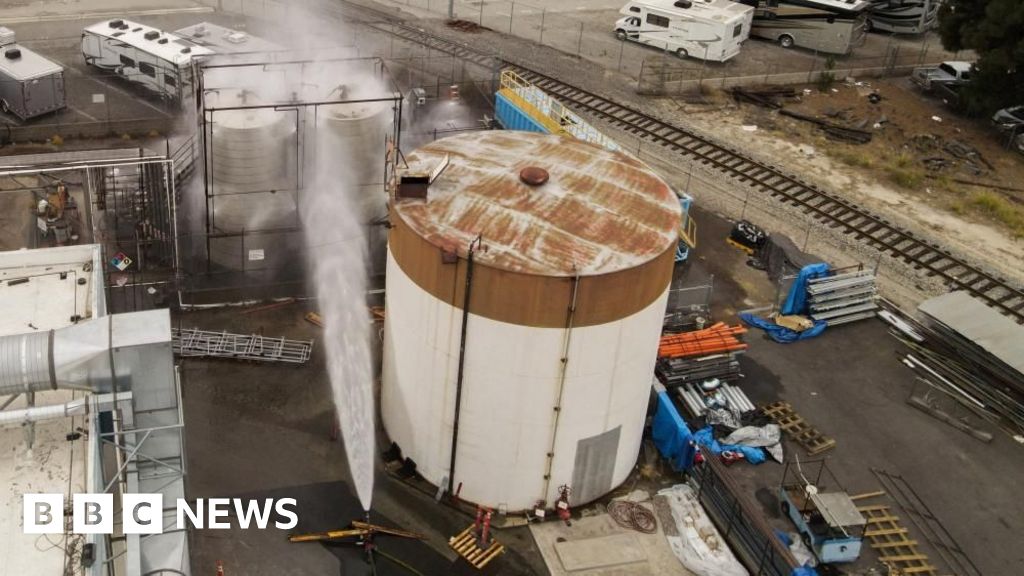
Officials said the threat of a BLEVE at the damaged chemical tank in Garden Grove has been eliminated after an overnight operation, with internal tank temperature falling from 100F to 93F. No active leak is currently reported, but about 50,000 people remain under evacuation orders while crews continue monitoring and containment work. The incident is largely a local safety event, though it highlights industrial-risk management at an aerospace facility handling methyl methacrylate.
The immediate market read is that this is a localized de-risking event rather than a broad industrial shock. The first-order loser would have been the operator’s airframe/defense manufacturing throughput and any nearby logistics nodes, but the bigger issue was tail-risk contagion: a prolonged evacuation can disrupt trucking, hazmat routing, and port-adjacent supply chains even after the acute hazard is contained. Now that the catastrophic outcome is off the table, the residual risk shifts from explosion to cleanup, investigation, and downtime, which tends to be a slower-burn earnings hit rather than a headline-driven shock.
The second-order winner is the municipal and environmental remediation complex: containment contractors, emergency response services, and specialty waste handlers often see follow-on work after the crisis headline fades. For adjacent industrial peers, the event is a reminder that chemical storage and process safety failures can trigger permitting scrutiny and insurance repricing across an entire subsector; that can modestly benefit best-in-class operators with stronger safety records and raise the cost of capital for laggards. Over a 1-3 month horizon, the key question is whether authorities convert this into stricter inspections and local restrictions that delay capacity restoration.
Consensus may be underestimating how fast the market will move on from the acute scare, which limits the trading value in “disaster avoided” names, while overestimating the durability of any negative sentiment on the operator. The cleaner trade is not a directional bet on the incident itself, but on the regulatory and remediation spillover: that tail can persist for quarters even if the immediate hazard is resolved in days. If there is a policy response, it will likely show up first in insurance premiums and capex guidance before it appears in reported revenue.
From a risk standpoint, the main reversal would be a delayed leak or evidence of broader site contamination, which could reintroduce evacuation and litigation risk quickly. Absent that, the market will likely fade the event within days, making short-dated volatility the only tradable dislocation. The asymmetry is in the follow-on costs, not the headline explosion risk.
AI-powered research, real-time alerts, and portfolio analytics for institutional investors.
Request DemoOverall Sentiment
mildly positive
Sentiment Score
0.15
