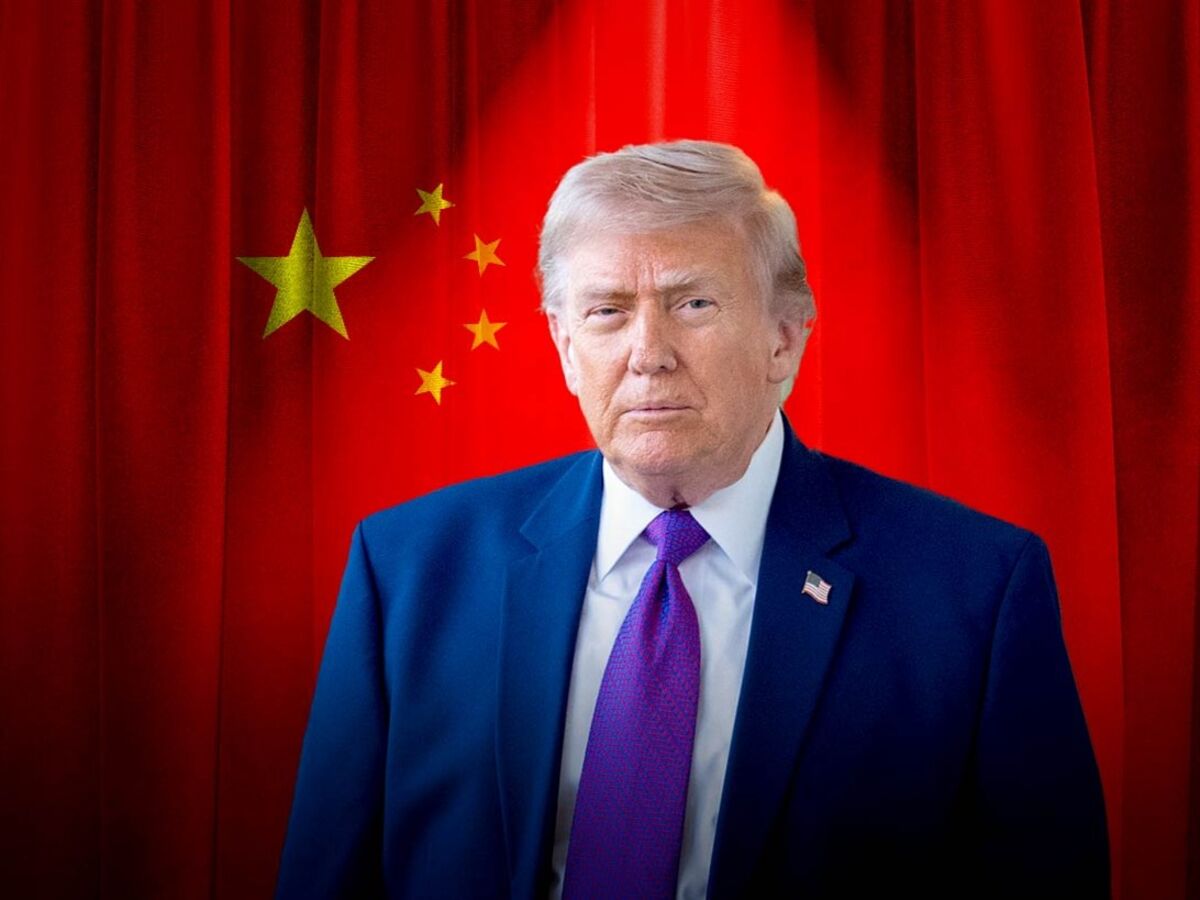
Trump arrived in Beijing for a high-stakes summit with Xi Jinping focused on stabilizing US-China ties amid the Iran war, Taiwan arms sales, and the AI race. The presence of Jensen Huang and Elon Musk lifted Nvidia, Tesla, and Chinese AI-related stocks, suggesting traders are pricing in improved tech dialogue and reduced friction. Overall tone is cautious but market-relevant, with geopolitics and AI policy likely to drive cross-asset sentiment.
The market is reading this as a de-escalation signal for US-China tech friction, but the more important second-order effect is bargaining leverage. If Washington signals flexibility on chips or tariffs to secure geopolitical coordination, the first beneficiaries are not just NVDA and TSLA — it is the broader cluster of AI supply chain names whose valuation depends on China access remaining quasi-open. The risk is that any headline-driven rally in semis is front-running a process that usually ends in incremental, not structural, concessions.
For NVDA, the key variable is not demand from China in the next quarter; it is the probability distribution around export controls over the next 6-18 months. A lighter-touch outcome could compress the implied geopolitical discount embedded in the multiple, but a failed summit would likely hit the stock via a double channel: lower China revenue assumptions and a higher policy risk premium across the AI hardware stack. TSLA’s setup is more nuanced because the stock trades on both China manufacturing optionality and AI narrative spillover, so even a modest thaw can lift sentiment without materially changing unit economics.
The contrarian miss is that a high-profile executive entourage can be read as evidence of desperation rather than strength — which means any positive reaction may be overextended if investors assume immediate policy relief. If Xi extracts concessions on Taiwan arms sales or Middle East coordination, the eventual US response could be more restrictive for tech, not less. The better trade is to treat this as a volatility event, not a clean directional regime shift.
Near term, the path dependency matters more than the summit outcome: 1-2 weeks of follow-through can drive momentum, but the risk reverses quickly if official readouts sound vague or transactional. In that case, crowded AI longs are vulnerable to a fast factor unwind as investors rotate back to domestically insulated growth names and defensives.
AI-powered research, real-time alerts, and portfolio analytics for institutional investors.
Request DemoOverall Sentiment
neutral
Sentiment Score
0.10
Ticker Sentiment
