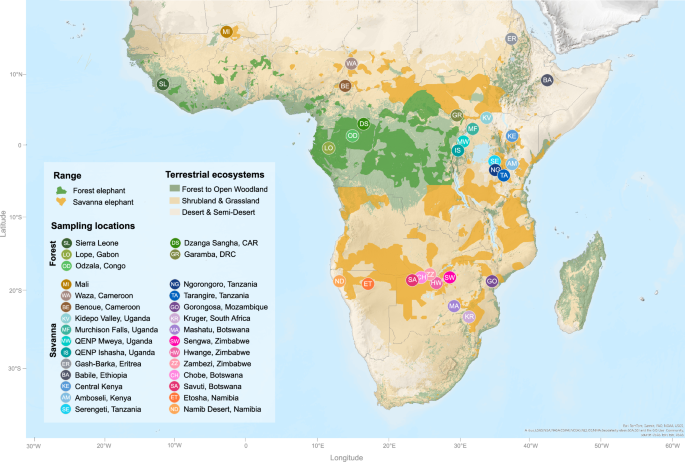
The study analyzes 232 high-coverage genomes from African elephants across 17 countries and finds deep divergence between savanna and forest elephants, plus widespread trace introgression of forest ancestry into savanna populations. Forest elephants show higher heterozygosity and historically larger effective population sizes, while savanna elephants exhibit greater inbreeding and genetic load, especially in fragmented or isolated regions. The article is primarily a conservation genomics paper with limited direct market relevance.
This is not a pure conservation headline; it is a validation event for the long-read sequencing toolkit in biodiversity genomics. The practical implication is that high-coverage, range-wide reference datasets are becoming a recurring product category, which supports consumables, sequencing, and analysis software demand even when the end-market is grant-funded and lumpy. The more important second-order effect is that these studies shift budgets from one-off marker panels toward recurring whole-genome monitoring, raising the ceiling for per-project spend and making platform selection stickier over multi-year conservation programs.
The contrarian angle is that the article’s biggest commercial signal is not “more data,” but “better provenance and enforcement.” If conservation agencies adopt genomic baselines for forensic tracing, anti-poaching adjudication, and corridor monitoring, the addressable use case extends beyond academic research into field-deployable assays and software subscriptions. That favors vendors with sample-to-answer workflows and library-prep simplification over pure instrument vendors, because the operational bottleneck in these programs is often throughput, contamination control, and interpretation rather than read generation.
There is also a subtle competition risk for lower-cost genotyping and legacy microsatellite workflows: once a continent-scale genomic baseline exists, the value of older panels compresses quickly. Over 12–36 months, that can redirect incremental conservation and biodiversity grant dollars toward broader NGS ecosystems, while leaving point-solution assay providers exposed unless they can bridge into regulatory or enforcement workflows. The other tail risk is that if field agencies interpret hybridization as a policy issue, demand may tilt toward custom panels and surveillance rather than large discovery sequencing, which could narrow near-term benefit to consumables and software rather than capex-heavy systems.
AI-powered research, real-time alerts, and portfolio analytics for institutional investors.
Request DemoOverall Sentiment
neutral
Sentiment Score
-0.10
Ticker Sentiment
