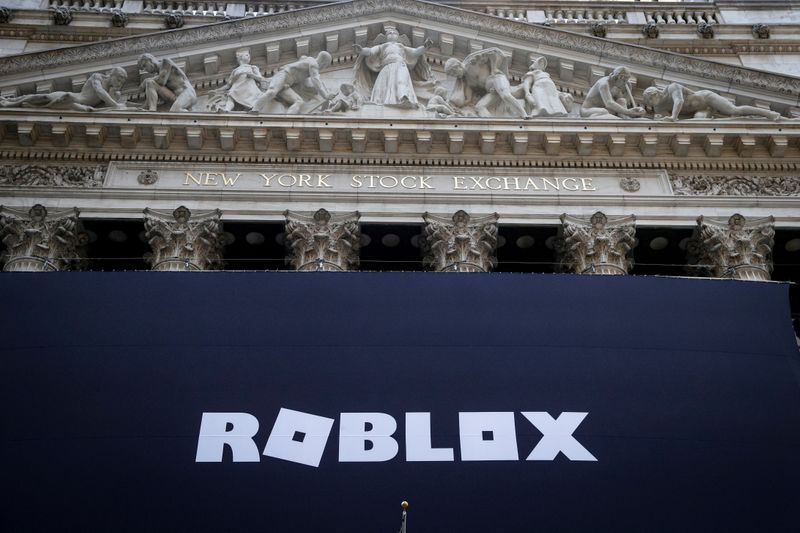
Roblox shares indicated down 20% to $44.89 after the company sharply lowered its 2026 bookings guidance, despite Piper Sandler reiterating an Overweight rating and $100 price target. The firm said the outlook remains challenging amid age-verification-related engagement headwinds, while Roblox’s recent quarter also showed daily active user growth of 35% versus 44% expected. Several other analysts have turned more cautious, including downgrades from BTIG and BofA and price-target cuts from Goldman Sachs, DA Davidson, and Canaccord.
RBLX is in the classic post-earnings de-rating phase where the market stops capitalizing long-duration optionality and starts discounting execution risk. The key second-order issue is not just slower bookings growth, but that age-verification friction can impair the platform’s liquidity loop: fewer seamless sessions reduce creator monetization, which then weakens content supply and raises the cost of user re-engagement. That makes this more than a one-quarter guidance reset; it can pressure forward engagement and take rate assumptions for several quarters if the product fix is cumbersome.
The selloff likely overshoots near-term fundamentals but may still undershoot the duration of the problem. If the company is forced into more safety/compliance layers, the near-term tradeoff is lower conversion and lower session depth versus a healthier long-term regulatory profile. The market is currently pricing the pain immediately and the benefit later; that asymmetry usually creates a tradable bounce, but only if management can show the verification funnel is stabilizing within 1-2 quarters.
Competitively, the biggest beneficiaries are adjacent interactive entertainment platforms and publishers that do not bear the same verification drag, because content discovery spend can shift quickly when users face friction. The stronger signal is to watch whether creator economics begin to soften; if that happens, the issue migrates from “growth slowdown” to “ecosystem deterioration,” which would justify another leg lower over 3-6 months. That said, because sentiment is already deeply negative, any sign of revised guidance discipline or improved retention after the rollout could trigger a sharp mean reversion rally.
AI-powered research, real-time alerts, and portfolio analytics for institutional investors.
Request DemoOverall Sentiment
strongly negative
Sentiment Score
-0.65
Ticker Sentiment
