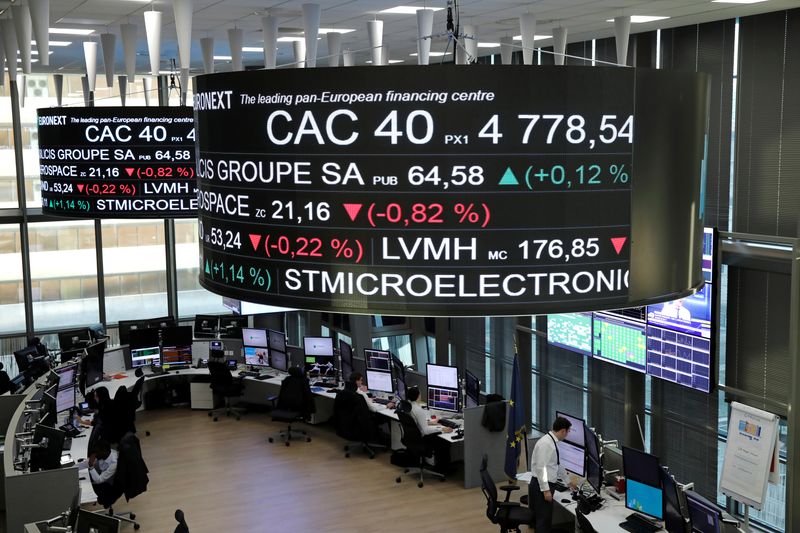
U.S. and Iran reportedly reached a peace deal to immediately halt hostilities and reopen the Strait of Hormuz, sending crude prices sharply lower and lifting European equities to fresh record highs. The STOXX 600 surged at the open, while France's CAC 40 rose 1.6%, Germany's DAX gained 1.8%, FTSE 100 added 0.9%, and FTSE MIB advanced 2.5%. Airline shares rallied on lower oil, with Air France up 5.2%, ICAG up 4.6%, and Lufthansa up 5.6%, while rate-sensitive real estate names also benefited from easing inflation and a softer rate-hike outlook.
The first-order winner is not just airlines and rate-sensitive cyclicals; it is the entire European macro beta basket because the shock lowers both input-cost uncertainty and terminal-rate risk at the same time. The second-order effect is a duration re-rating in Europe: if energy stays contained for several weeks, earnings revisions should improve in consumer discretionary, REITs, and industrials faster than in the U.S., where the disinflation impulse is weaker. That creates a relative-value tailwind for Europe versus U.S. equities over the next 1-3 months, especially in sectors with high imported-energy sensitivity.
The bigger loser is the inflation trade. A sustained reopening of Hormuz removes the market’s easiest tail-risk hedge, so systematic oil longs, energy equities, and commodity-vol control overlays can all unwind together; that means the move can overshoot to the downside in the next few sessions as trend-followers de-gross. The cleaner read-through is that lower headline inflation gives central banks cover to stay patient, but if growth data are already soft, the market will quickly shift from "less hawkish" to "more easing," which is supportive for REITs and homebuilders beyond the initial relief rally.
The main risk is that this is a headline-driven gap move before verification. Any slippage in implementation, shipping disruptions, or renewed proxy incidents would reprice crude immediately because positioning has likely flipped from protection to relief in a matter of hours. Over the medium term, even a durable peace deal could be bearish for some defense-adjacent names and bullish for Asia-bound shipping lanes, but the near-term trade is still dominated by the squeeze in energy premia and volatility collapse.
The contrarian angle is that the market may be underestimating how much of the move is already in the tape after the first signal on Friday. If crude is now pricing a perfect reopening, the risk/reward shifts toward fading the largest beneficiaries on strength and buying the laggards that benefit from lower rates and lower fuel costs with less geopolitical optionality. In other words, the best trade may be relative value rather than outright beta.
AI-powered research, real-time alerts, and portfolio analytics for institutional investors.
Request DemoOverall Sentiment
strongly positive
Sentiment Score
0.78
