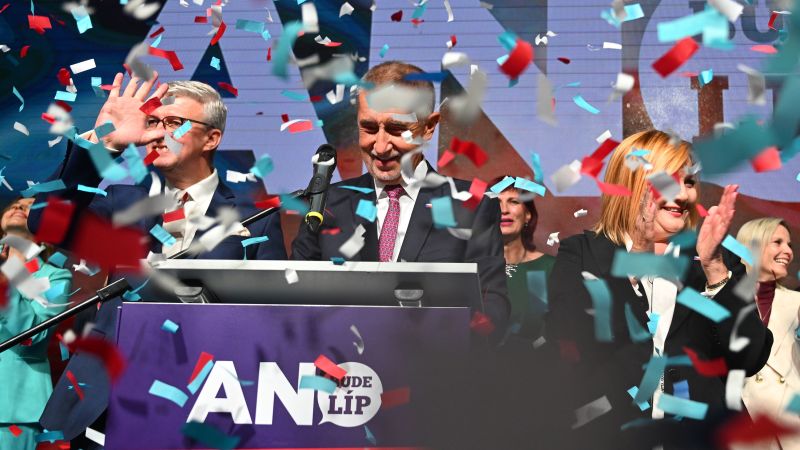
Andrej Babis's populist ANO party secured a victory in the Czech parliamentary election with 34.7% of the vote, positioning him to form a government that could significantly alter the nation's foreign and domestic policies. Babis, a eurosceptic and ally of Hungarian leader Viktor Orban, aims to end the 'Czech initiative' providing artillery to Ukraine and opposes its EU membership, despite claiming to be pro-EU and pro-NATO. Domestically, ANO has pledged billions in spending for faster growth, higher wages, pensions, and tax cuts, signaling an end to austerity measures, though Babis will need to overcome legal hurdles and secure coalition partners from parties including the far-right SPD.
Billionaire Andrej Babis’s ANO party cruised to victory in the Czech Republic’s parliamentary election on Saturday, raising the prospect of a government that would boost Europe’s populist, anti-immigration camp and reduce support for Ukraine. An ebullient Babis told supporters that ANO would seek a one-party cabinet but would talk with two small parties – including the far-right SPD – for support as his party will lack an outright majority. He again rejected accusations that his win would make the central European nation a less reliable European Union and NATO partner. Who will Babis team up with? “We want to save Europe … and we are clearly pro-European and pro-NATO,” Babis told reporters. With nearly all results in, ANO was set to replace the current center-right cabinet led by Prime Minister Petr Fiala. Fiala congratulated Babis and conceded defeat. ANO promised faster growth, higher wages and pensions, and lower taxes and tax discounts for students and young families during the campaign. Those pledges – that will cost billions of euros, end austerity and test the country’s frugal mindset – resonated with many Czechs who have seen their real incomes plunge in recent years as the country tackled soaring inflation. Babis, however, must overcome some hurdles to become prime minister, including conflict-of-interest laws as owner of a chemicals and food empire and long-running fraud charges related to drawing an EU subsidy over 15 years ago – charges he denies. With 99% of voting districts counted, ANO was leading on 34.7% and Spolu in second on 23.2%, the Statistical Office said. President Petr Pavel, who will appoint the next prime minister, was expected to start talks with party leaders on Sunday. ANO was seen winning around 80 seats in the 200-seat lower house, results projections showed, and so will need to find wider support. Babis said he would talk to the Motorists, who oppose the EU’s Green policies, and the anti-EU and anti-NATO SPD. Motorists leader Petr Macinka said he was open to talks with ANO, as did SPD. ‘Strong Czechia’ “We went into the election with the aim of ending the government of Petr Fiala and support even for a minority cabinet of ANO is important for us and it would meet the target we had for this election,” SPD Deputy Chairman Radim Fiala said on television. Overall, the fringe pro-Russian parties fared worse than expected in the partial results, with SPD on 7.8% and the far-left Stacilo!, built around the Communist Party, below the 5% threshold to enter parliament. Babis, who led a center-left cabinet in 2017-2021, once wanted to join the euro but has since become a eurosceptic and a supporter of US President Donald Trump, handing out “Strong Czechia” baseball caps inspired by Trump’s MAGA slogan. An ally of Hungarian leader Viktor Orban, Babis has teamed up with a number of far-right parties in the Patriots for Europe group in the European Parliament to challenge the mainstream direction of Europe’s policies, including decarbonisation. He has rejected calls from SPD to hold a referendum on leaving the EU and NATO, but has said he would end the “Czech initiative” that has bought millions of artillery rounds from around the world for Ukraine with funding from Western donors. ANO wants NATO and the EU to handle aid for Ukraine, and has abstained in some European Parliament votes supporting Kyiv and its bid for EU membership, which Babis has opposed in the past. The decisive victory of Andrej Babis's ANO party, securing 34.7% of the vote, signals a significant political and economic pivot for the Czech Republic, introducing considerable uncertainty for investors. The primary challenge is government formation, as ANO's projected 80 seats in the 200-seat house will necessitate a coalition, potentially with the far-right, anti-NATO SPD party. This introduces geopolitical risk, underscored by Babis's intention to halt the 'Czech initiative' supplying artillery to Ukraine and his alignment with eurosceptic leaders like Viktor Orban, potentially straining relations with the EU and NATO despite his public assurances. On the domestic front, a sharp fiscal expansion is planned, with promises of higher wages, pensions, and tax cuts amounting to billions of euros, marking an end to the previous government's austerity. This policy, a direct response to voter concerns over inflation-eroded incomes, could pressure the nation's budget and complicate the inflation outlook. Compounding these policy uncertainties are the significant legal and governance risks surrounding Babis himself, including long-running fraud charges and conflict-of-interest concerns, which could undermine political stability.
AI-powered research, real-time alerts, and portfolio analytics for institutional investors.
Request DemoOverall Sentiment
moderately negative
Sentiment Score
-0.50
Ticker Sentiment
