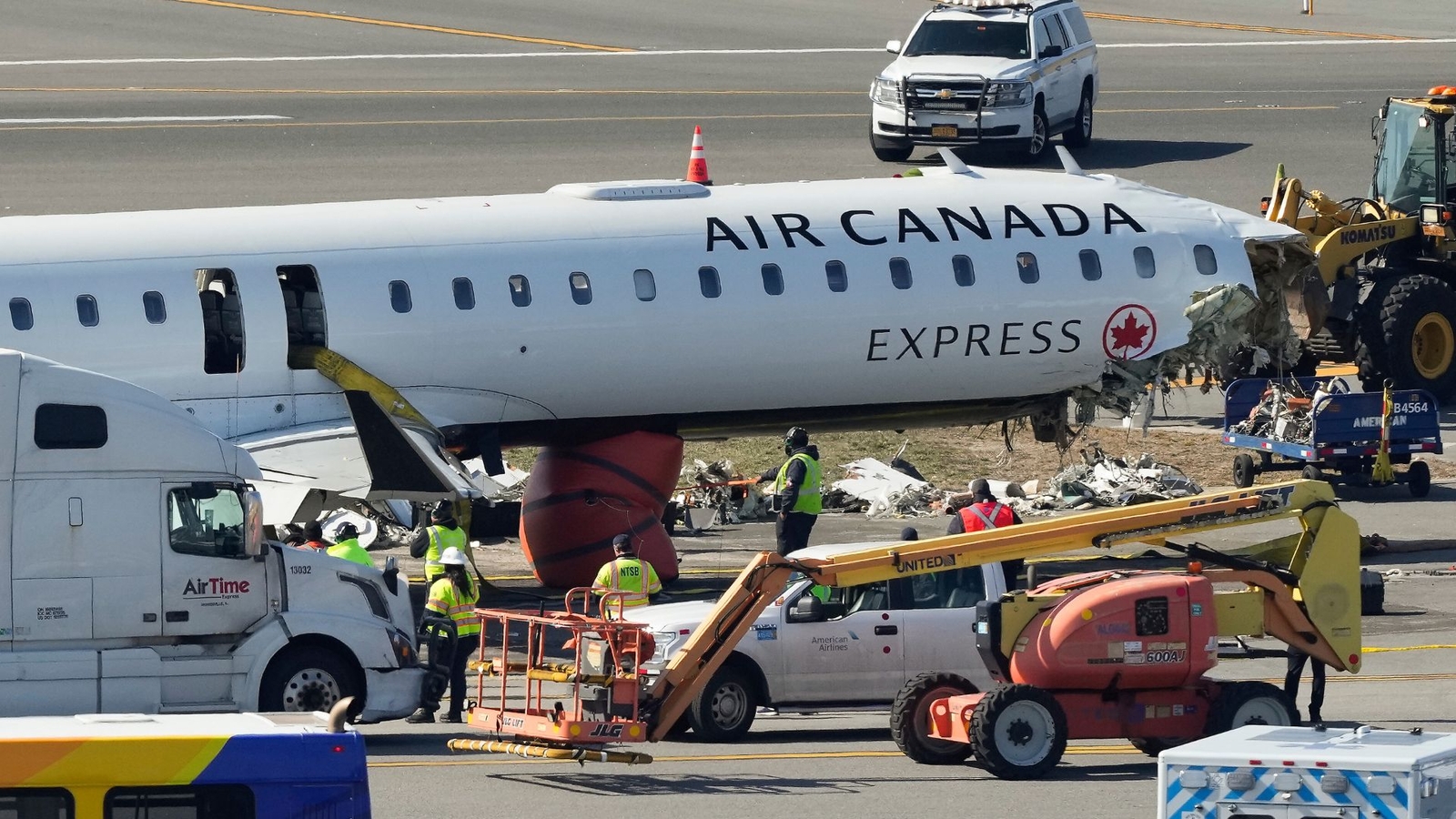
The NTSB's preliminary report on the March 22 LaGuardia crash says the firetruck and pilot both attempted to swerve seconds before impact, and runway warning lights were functioning at the time. Two pilots died, two truck crew members were hospitalized, and about 40 passengers and crew were injured. The report does not assign a final cause; the full investigation is expected in 12-24 months.
This is less a one-off accident headline than an aviation-process stress test, and the market will likely treat it that way once the liability chain becomes clearer. The key second-order issue is not just the direct lawsuit value; it is the probability of broader operational changes around tower staffing, surface movement controls, and airport emergency coordination at constrained hubs. That tends to lift compliance, training, and automation spend across airport services while pressuring operators with the most labor-constrained or high-complexity ground operations.
The near-term beneficiary set is asymmetric. Vendors tied to runway safety, tower software, surveillance, and airport infrastructure modernization should see incremental demand as airports preemptively audit ground vehicle protocols and conflict-detection systems. The losers are more likely to be legacy ground-handling and regional aviation operators with thin margins, where even a modest jump in insurance premiums, training requirements, or staffing redundancy can compress EBITDA by low single digits over the next 12-24 months.
The market may be underpricing the litigation tail because the final causality determination is months away, but the operational response starts now. If investigators ultimately frame staffing/coordination as a contributing factor, expect a wave of airport authority capex, FAA scrutiny, and insurer repricing that outlives the legal case by years. That creates a durable procurement cycle for safety tech, while also making any operator exposed to airport ground incidents more vulnerable to negative revisions.
Contrarian angle: the first reaction will be to sell anything aviation-adjacent on headline risk, but that is probably too blunt. The better expression is to fade operators and own picks-and-shovels safety beneficiaries, because airports usually overcorrect after high-profile incidents and that spend is harder to defer than traffic-driven revenue. The opportunity is in the second-order capex cycle, not in the immediate accident headline.
AI-powered research, real-time alerts, and portfolio analytics for institutional investors.
Request TrialOverall Sentiment
moderately negative
Sentiment Score
-0.45
