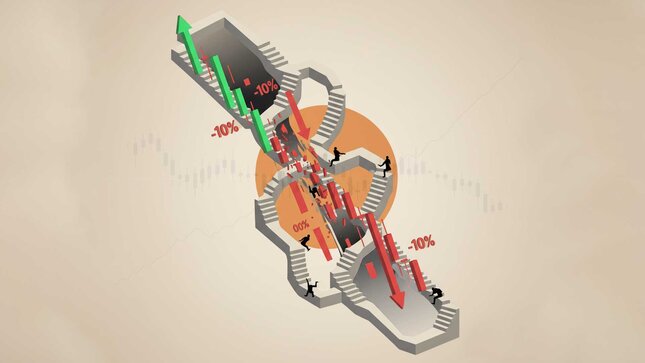
The article argues that war headlines mainly transmit into oil, front-end rates, and FX, with Brent around $95 and a potential $120 crude level cited as the point where stocks may start to feel real macro damage. It notes Nasdaq’s asymmetric reaction to oil moves, while Schatz (German 2-year) remains closely linked to crude, and says front-end rates or oil are better trades than NQ futures for war news. It also highlights Polymarket earnings probabilities as a useful signal for post-earnings trading, especially in names like TSLA.
The key market takeaway is that war headlines are not a clean equity beta event; they are a volatility and policy-transmission event. The fastest repricing should continue to sit in front-end rates and crude because those are the channels where energy shocks alter inflation expectations, central-bank reaction functions, and term-premium dynamics within days, not quarters. That makes the current setup more favorable for relative-value expressions in rates/FX than for outright index shorts, especially while AI capex and fiscal impulse keep large-cap US equities insulated from energy shocks below the kind of crude level that truly compresses margins and consumer demand.
The more interesting second-order effect is that the relationship between oil and risk assets is becoming more asymmetric, which means naive correlation trades are increasingly dangerous. When oil spikes, equities may only de-rate modestly unless the move is large enough to threaten growth or force policy tightening; when oil falls, high-duration tech can re-expand sharply. That asymmetry argues for optionality rather than linear exposure, and for focusing on assets where transmission is direct and fast: short-end rates in Europe and the US, plus FX pairs with cleaner oil sensitivity and less crowded positioning.
The article also flags a subtle positioning regime shift: broad USD short-covering has already reduced FX beta, so the next war-related move in FX is more likely to be idiosyncratic than broad dollar weakness/strength. In single names, the weakest links are still those with direct household or input-cost exposure and weak pricing power; that matters more for JNJ and TSLA than for the megacap index basket. TSLA is especially interesting because its earnings/implied-event setup can still be mispriced when consensus leans too heavily on headline macro and not enough on forward guidance dispersion.
The contrarian read is that the market may be underpricing tail risk in crude, but overpricing immediate equity damage. If Brent grinds toward the prior highs, the first-order pain is not necessarily NQ; it is a tightening of real financial conditions through rates, credit spreads, and consumer sentiment over 1-3 months. That leaves room for a delayed equity drawdown, but the cleaner trade is to own convexity where the transmission is strongest and avoid paying up for broad index hedges that can decay while the market shrugs off the news.
AI-powered research, real-time alerts, and portfolio analytics for institutional investors.
Request TrialOverall Sentiment
neutral
Sentiment Score
0.05
Ticker Sentiment
