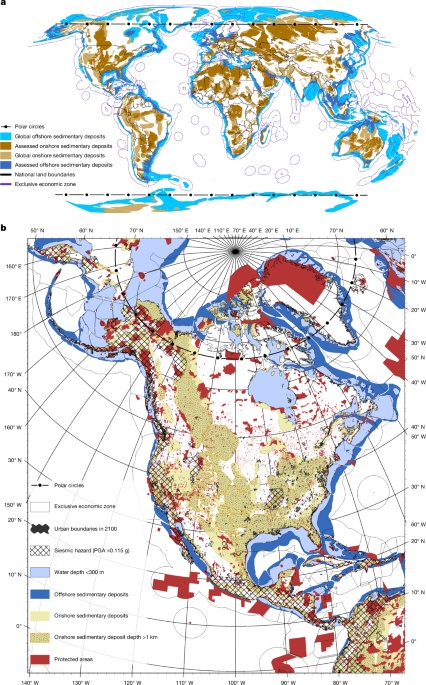
A new risk-based analysis establishes a prudent planetary limit for geologic carbon storage at approximately 1,460 GtCO2, an order of magnitude lower than commonly assumed technical potentials, due to geological, environmental, and policy constraints. This finite capacity implies that only stringent near-term emissions reductions can prevent exceeding this limit before 2200, and that utilizing the full potential for durable CO2 removal would cap global temperature reduction at around 0.7°C. Consequently, the findings necessitate a fundamental re-evaluation of national mitigation strategies, underscoring the critical importance of treating geologic carbon storage as a scarce, intergenerational resource rather than a limitless commodity, as many current climate scenarios project exceeding this revised capacity.
A new risk-based analysis establishes a prudent planetary limit for geologic carbon storage at approximately 1,460 GtCO2, a figure which is an order of magnitude lower than the 10,000–40,000 GtCO2 technical potential often cited in climate models. This significant downgrade results from applying realistic exclusion criteria, including seismic hazards, environmental conservation areas, proximity to population centers, and policy risks, fundamentally reframing carbon capture and storage (CCS) as a finite and scarce resource rather than a near-limitless backstop. The implications are profound for energy and industrial sectors, as many corporate and national net-zero strategies rely on CCS deployment at a scale that now appears unsustainable; scenarios aiming for 1.5°C may require up to 2,000 GtCO2 of storage, exceeding this prudent limit. The study indicates that at current policy trajectories, this carbon budget would be exhausted before 2200, and that even full utilization for carbon removal would cap temperature reversal at a modest 0.7°C. Geographically, the analysis reveals a stark disparity, with nations like Russia, the USA, and China retaining robust potential while Europe, India, and Canada face major reductions, suggesting future geopolitical dependencies and opportunities for incumbent oil and gas firms in storage-rich nations.
AI-powered research, real-time alerts, and portfolio analytics for institutional investors.
Overall Sentiment
moderately negative
Sentiment Score
-0.40
Ticker Sentiment
