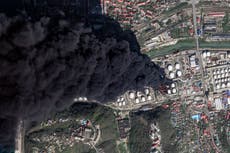
Russia and Ukraine traded fresh strikes amid a ceasefire standoff, with overnight attacks in Ukraine killing at least five people, including Naftogaz employees and emergency workers, while a Ukrainian drone attack reportedly killed two in Russia's Chuvashia region. Moscow has threatened a "massive missile strike" if Victory Day events are disrupted, and both sides are preparing for heightened military and internet restrictions around the May 8-9 celebrations. The UK also imposed 35 new sanctions on Russian trafficking networks, and the EU-Ukraine loan discussion adds to broader war-related financial and defense pressure.
The market read-through is not a generic “war bad” tape; it is a higher-probability escalation in localized energy sabotage with a very asymmetric effect on European distillates and regional power prices. The key second-order issue is not just headline volatility but the deliberate targeting of gas processing, refining, logistics, and civil infrastructure around Victory Day, which raises the odds of intermittent outages, emergency rerouting, and security-driven downtime across the Black Sea energy corridor over the next 1-4 weeks.
That shifts the relative winners/losers inside energy: upstream commodity exposure is less compelling than names with direct exposure to Russian/European refined product tightness or non-Russia replacement supply. European utilities, industrials, and transport are the immediate losers if the rhetoric turns into a temporary but recurring hard stop on pipelines, ports, and grid assets; the more interesting longer-duration effect is that every successful strike accelerates de-risking of Russian supply chains and increases the structural premium for non-Russian LNG, diesel, and defense-logistics capacity.
The most underappreciated catalyst is the information-war overlay around the ceasefire window. Markets often fade symbolic truces, but the combination of internet throttling in Moscow, explicit retaliatory threats, and visible civilian shelter preparations increases the probability of a miscalculation that forces a sharp one- to three-session risk-off spike in European cyclicals and EM beta. If no major incident occurs through the holiday window, the immediate volatility impulse should fade quickly; the deeper story remains intact, though, because each round of infrastructure strikes raises the steady-state cost of operating in the region.
Contrarian view: the market may be overpricing a sustained oil spike and underpricing defense, security, and non-Russian energy substitution. This is not a classic global supply shock unless attacks broaden materially; it is more likely a persistent regional margin compression story for Europe with selective upside in defense and LNG infrastructure. The best asymmetric setup is to own beneficiaries of prolonged security spending and energy diversification rather than chase broad crude beta.
AI-powered research, real-time alerts, and portfolio analytics for institutional investors.
Request DemoOverall Sentiment
strongly negative
Sentiment Score
-0.70
