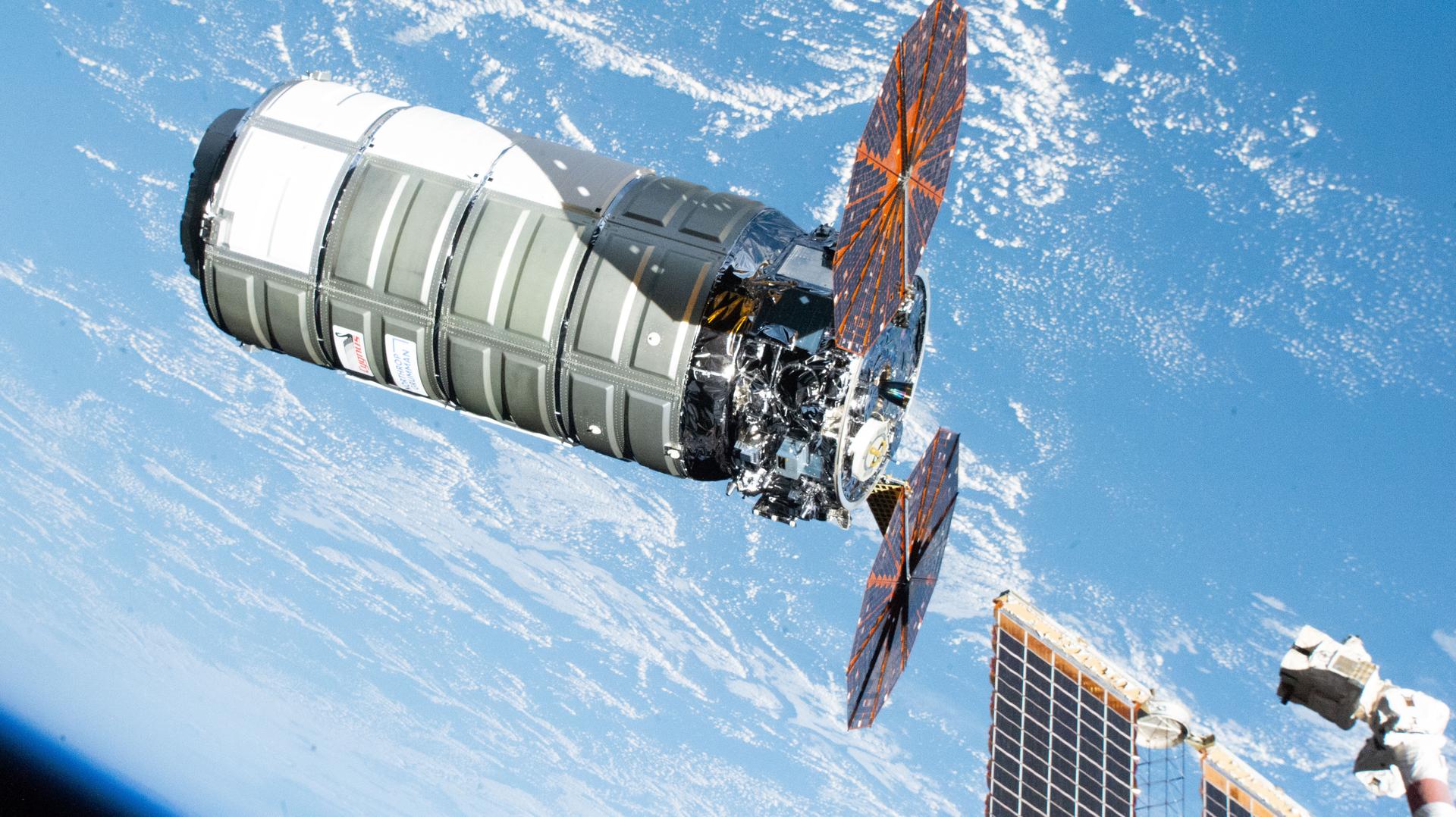
Expedition 74 opened Northrop Grumman’s Cygnus XL after robotic capture and began unloading more than 2,300 pounds of research hardware, science experiments, and crew supplies. The cargo includes time-critical biological samples, an advanced exercise system, eye-imaging hardware, gas tanks for suit recharge, and a quantum physics module for the Cold Atom Lab. The article is routine ISS operations reporting with no clear market-moving implications.
This is a quiet positive for NOC, but the bigger signal is not the cargo handoff itself — it is the validation of a higher-throughput logistics cadence in low-Earth orbit. That matters because commercial resupply is gradually shifting from an episodic contract service to a recurring infrastructure layer, which should support better visibility on follow-on missions, incremental payload mix, and pricing power for capable incumbents. In other words, the value is less in one launch and more in the compounding credibility of the platform. The second-order winner is likely the broader space supply chain: cryogenic handling, life-science payload integration, robotics, and environmental-control subsystems all get pulled forward by more frequent station utilization. That can benefit adjacent names with exposure to space hardware, thermal management, and mission services even if they are not named here. The article also reinforces that the market for orbital science is becoming more diverse, which raises the odds of budget durability for programs tied to biotech, microgravity research, and astronaut support equipment over the next 12-24 months. The main risk is that investors over-interpret a single successful servicing event as a near-term revenue step-function. For NOC, the economic impact is likely gradual unless this translates into a larger backlog, higher flight rate, or evidence of margin expansion in the space business; absent that, the stock can fade back to defense-program fundamentals. A smaller but real tail risk is operational: any contamination, handling issue, or schedule slip in the cargo/crew rotation sequence could delay science utilization and push revenue recognition later than expected. Contrarian angle: the market may be underestimating how much recurring logistics can resemble an annuity if station extensions and private-orbit buildout accelerate. If that thesis gains traction, the right trade is not a broad space basket, but owning the high-reliability integrators and mission operators while shorting lower-quality aerospace names that lack a credible recurring service model.
AI-powered research, real-time alerts, and portfolio analytics for institutional investors.
Request DemoOverall Sentiment
neutral
Sentiment Score
0.12
Ticker Sentiment
