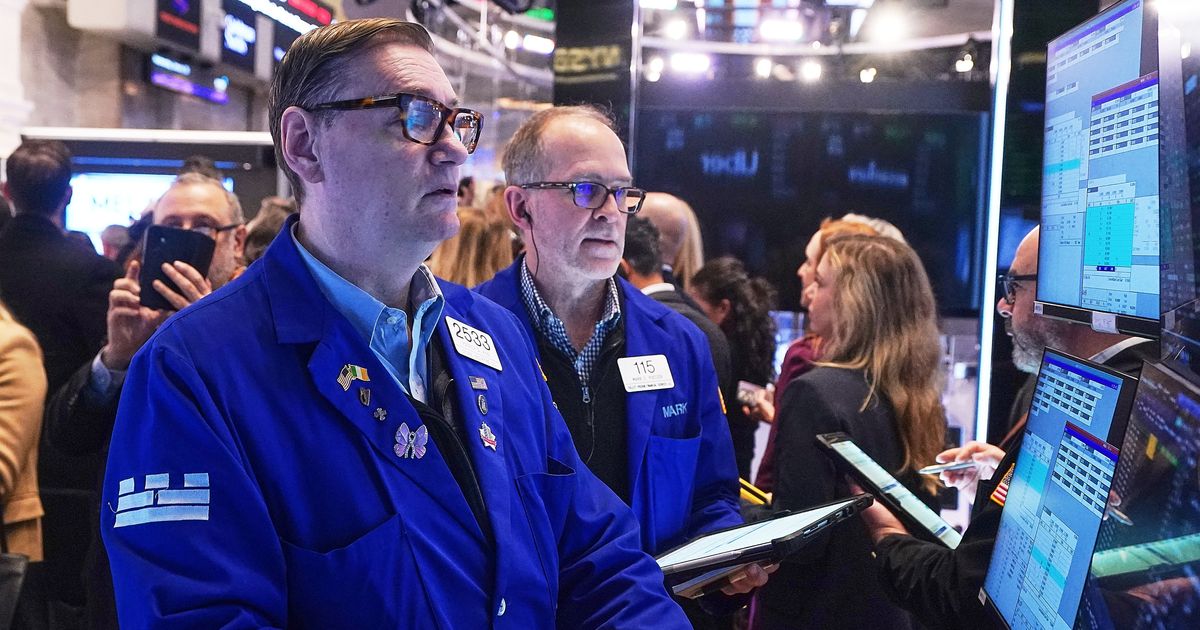
U.S. equities traded around record highs as the S&P 500 rose 0.1%, the Dow fell about 63 points (−0.1%) and the Nasdaq gained 0.4%, helped by AI-linked strength after ASML topped expectations and gave a bullish 2026 revenue outlook; Nvidia climbed 1.7%. Several earnings surprises moved individual names — Seagate jumped 16.8% on better-than-expected profit and revenue, Starbucks +5.3% on revenue beats despite weaker profit, Elevance +4.9%, while Amphenol plunged 12.8% after elevated expectations. The dollar stabilized after dipping to its weakest since early 2022, gold surged 3.5% to $5,258.70/oz, and the 10-year Treasury yield was about 4.25% as markets positioned cautiously ahead of a widely expected Fed rate hold.
Market structure: The ASML beat and NVDA strength confirm AI-driven capex is shifting incremental share toward lithography and high-end memory/storage suppliers (ASML, NVDA, STX) over legacy interconnect/component names (APH). Expect 6–18 month revenue reallocation: equipment & memory demand up 15–30% in best-case channel restocking, while mid-cycle component vendors face margin compression as expectations reprice. The USD decline and gold >$5,258.70 signal cross-border flows out of dollar assets, amplifying sector rotation into cyclicals and commodities.
Risk assessment: Tail risks include a sharp US policy-driven equity outflow (“Sell America”) or US tariffs/regulatory action that could cut multinational sales 5–15% within 3–12 months; another is rapid inventory destocking in semiconductors producing a revenue rollback of 20–40% for suppliers in 2–4 quarters. Near-term (days–weeks) drivers are the Fed decision and Apple earnings; medium-term (3–12 months) drivers are capex guides from ASML/NVDA and US trade policy. Hidden dependency: AI strength is contingent on hyperscaler stocking cycles — outsize positive prints can reverse if hyperscalers pause purchases.
Trade implications: Favor selective long exposure to NVDA and STX while trimming or hedging exposed names like APH and long-duration tech that rely on consumer spend (AAPL ahead of earnings). Use barbell fixed-income: cut duration (target portfolio duration <2 years) and increase floating-rate exposure by 2–4% to protect against sticky inflation. FX/commodity plays: allocate 2–3% to gold (GLD or physical) and consider tactical EUR/USD long if DXY stays below its early-2022 lows for 2–4 weeks.
Contrarian angles: Consensus of durable AI demand may be overstated — ASML’s guide could reflect customer restocking, not structural demand; price multiples on NVDA are crowded (implied vols elevated). The market may be underpricing policy/regulatory risk (tariffs, AI export controls) that could trim EPS by 5–10% for multinationals over 12 months. If gold continues >$5,000 and 10yr holds >4%, expect rotational retracement in high-multiple names and a re-rating toward industrial semiconductors and commodity-linked miners.
AI-powered research, real-time alerts, and portfolio analytics for institutional investors.
Request DemoOverall Sentiment
neutral
Sentiment Score
0.12
Ticker Sentiment
